Escape
Бегство
Умному — с почтением.
Распад системы почти никогда не приносит свободы.
Он приносит панику.
Человек страдает не только от несвободы,
но и от необходимости стоять без опоры.
Когда рушится старая клетка, он редко хочет свободы.
Он хочет новую — быстрее, крепче, с красивым названием.
Свобода — это потеря всех поручней.
В ней не за что спрятаться.
Ни за государством, ни за идеологией, ни за коллективом, ни за моралью, ни за историей.
Для одних — шанс.
Для других — приговор.
Она не спасает, не оправдывает и не ведёт.
Она оставляет человека наедине с собой.
После каждого распада люди мгновенно восстанавливают то, что якобы отвергли.
Меняется не принцип.
Меняется форма.
Одна зависимость сменяет другую и гордо называется освобождением.
Коллективизм, рынок, нация, либерализм, технократия — разные режимы одной дрессировки.
Одни ломают страхом и дефицитом.
Другие — комфортом, престижем и чувством принадлежности.
Итог всегда один: человек отдаёт себя, лишь бы не нести собственный вес.
Здесь рождается главное явление эпохи:
ЭКЗИСТЕНЦИАЛЬНО-ИНТЕЛЛЕКТУАЛЬНЫЙ МАЗОХИЗМ.
Потребность в несвободе, вооружённая интеллектом.
Человек боится свободы и превращает страх в добродетель.
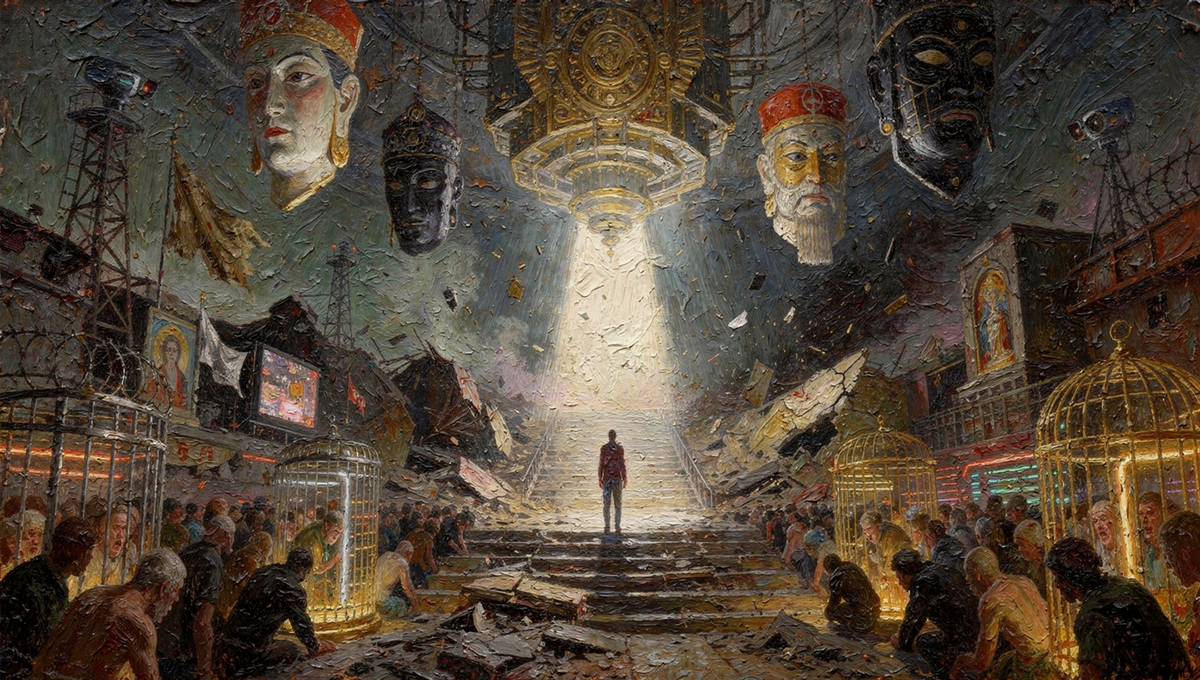
Он сам строит клетку, сам её украшает, сам называет её разумом, моралью и необходимостью.
Интеллект перестаёт освобождать.
Он охраняет вход.
Это уже не конформизм.
Это внутреннее согласие.
Человек не просто живёт внутри ограничений — он создаёт им философию, этику и эстетику.
Он убеждает себя, что за пределами клетки — только хаос.
Потому что не выносит мира, где нет окончательной опоры.
В этом катастрофа.
Не в существовании власти.
А в том, что человек снова и снова вступает с ней в союз.
Он не только терпит её.
Он её ищет.
Он не просто подчиняется.
Он хочет, чтобы подчинение имело смысл.
Он не просто бежит от свободы.
Он презирает того, кто напоминает: это бегство — его собственный выбор.
Главный разрыв проходит не между левыми и правыми, не между Востоком и Западом, не между империями и демократиями.
Он проходит внутри одного сознания.
В одном движении человек хочет готовую схему, чтобы не смотреть в пустоту.
В другом — понимает, что любая схема условна, и всё равно цепляется за неё.
Свободен не тот, кто сменил одну клетку на другую.
Свободен тот, кто увидел искусственность всех клеток
и свою собственную склонность цепляться за них как за гарантию себя.
Это тяжёлая позиция.
Она не утешает.
Не даёт тепла.
Не даёт самодовольства.
Зрелость не в том, чтобы жить вне форм.
Зрелость в том, чтобы пользоваться ими, точно зная им цену.
Человек всё равно действует, строит институты и говорит на языке своей эпохи.
Вопрос лишь в том, делает ли он это с ясным пониманием их условности — или снова ищет, в чём бы раствориться.
Пока человек ищет новую клетку — он не мыслит.
Он просто выбирает следующую форму зависимости.
И называет это жизнью.
Escape
For Brainbox — with respect.
Systems don't collapse into freedom.
They collapse into panic.
A person suffers not only from captivity
but from having to stand without support.
When the old cage breaks, he rarely wants freedom.
He wants a new one — faster, stronger, with a better name.
Freedom is the loss of every handrail.
There is nothing to hide behind.
Not the state, not ideology, not the collective, not morality, not history.
For some — a chance.
For others — a sentence.
It doesn't save, justify, or lead.
It leaves a person alone with himself.
After every collapse, people instantly rebuild what they claimed to reject.
The principle doesn't change.
The form does.
One dependency replaces another and proudly calls itself liberation.
Collectivism, markets, nationalism, liberalism, technocracy — different regimes of the same training.
Some break you with fear and scarcity.
Others — with comfort, status, and the feeling of belonging.
The result is always the same: a person gives himself away just to avoid carrying his own weight.
This is where the defining phenomenon of the age is born:
EXISTENTIAL-INTELLECTUAL MASOCHISM.
The need for unfreedom, armed with intellect.
A person fears freedom and turns that fear into virtue.
He builds the cage himself, decorates it himself, and calls it reason, morality, and necessity.
The intellect stops liberating.
It guards the entrance.
This is no longer conformism.
This is internal consent.
A person doesn't just live inside limitations — he builds them a philosophy, an ethics, an aesthetic.
He convinces himself that beyond the cage there is only chaos.
Because he cannot bear a world with no final ground to stand on.
Here is the catastrophe.
Not in the existence of power.
But in the fact that a person enters into alliance with it again and again.
He doesn't just tolerate it.
He seeks it.
He doesn't just submit.
He needs the submission to mean something.
He doesn't just run from freedom.
He despises anyone who reminds him: this escape was his own choice.
The real divide is not between left and right, not between East and West, not between empires and democracies.
It runs through a single consciousness.
In one movement, a person wants a ready-made map so he doesn't have to look into the void.
In another — he understands that every map is provisional, and clings to it anyway.
Free is not the one who traded one cage for another.
Free is the one who saw the artificiality of all cages
and his own tendency to grip them as a guarantee of himself.
This is a hard place to stand.
It offers no comfort.
No warmth.
No self-satisfaction.
Maturity is not living outside all forms.
Maturity is using them while knowing exactly what they're worth.
A person still acts, builds institutions, and speaks the language of his era.
The only question is whether he does it with a clear understanding of their contingency —
or whether he's looking, once again, for something to dissolve into.
As long as a person is searching for a new cage — he is not thinking.
He is simply choosing his next form of dependence.
And calling it a life.
Systems don't collapse into freedom.
They collapse into panic.
When the old cage breaks, a person rarely wants freedom.
He wants a new one — faster, stronger, with a better name.
Freedom is the loss of every handrail.
For some — a chance.
For others — a sentence.
After every collapse, people rebuild what they claimed to reject.
One dependency replaces another — and proudly calls itself liberation.
This is the defining phenomenon of the age:
EXISTENTIAL–INTELLECTUAL MASOCHISM.
The need for unfreedom, armed with intellect.
He builds the cage himself and calls it reason, morality, necessity.
The intellect stops liberating.
It guards the entrance.
He doesn't just tolerate power.
He seeks it.
Free is the one who saw the artificiality of all cages.
Maturity is using forms while knowing exactly what they're worth.
As long as a person searches for a new cage — he is not thinking.
He is choosing his next form of dependence.
And calling it a life.