Лестница убрана / The Ladder Has Been Removed

Лестница убрана?
Знание никогда официально не запрещали. Его цензурировали, прятали в закрытых архивах, запирали в монастырских библиотеках, шифровали мёртвыми языками, отгораживали дорогим университетским допуском. Но сама возможность прочесть, понять, войти сохранялась. Это была борьба за доступ.
Новая операция устроена иначе. Библиотеки открыты. Тексты оцифрованы. Многие архивы доступны круглосуточно. Но инструменты, которыми мышление превращает текст в знание, планомерно изымаются. Не запрещаются. Просто перестают быть нужными.
Падеж — не украшение грамматики. Это когнитивная операция. Беспредложный родительный в русском — тренажёр удержания неразрешённого отношения: «слух тишины» не выбирает, кому принадлежит акт слышания. Мышление, выращенное в такой морфологии, структурно способно к амбивалентности без тревоги, к удержанию небинарного. Это инструмент не декоративный, а функциональный.
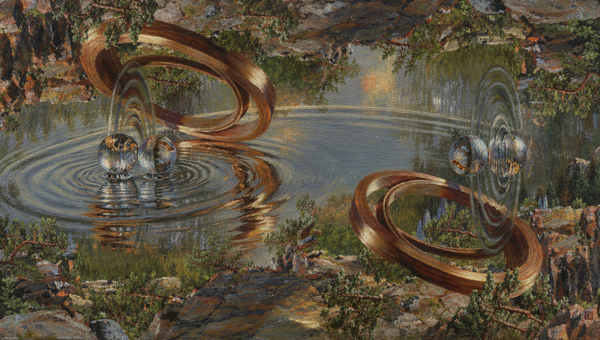
Английский язык в своей бинаризующей логике убирает этот инструмент. Не злонамеренно, а структурно. Он вводит различение там, где прежде его не было. Субъект отделяется от объекта. Сторона фиксируется. Лента Мёбиуса разрезается в цилиндр. Форма возникает — ценой утраты нерасчленённого поля.
Это и есть демиургический принцип в точном смысле: не злой вредитель, а топологически‑эволюционный оператор, уплощающий многомерное поле до управляемой конфигурации. Проблема не в самом разрезе — без него вообще не было бы понимания формы. Проблема в амнезии: Демиург забывает ленту, из которой был вырезан, и начинает считать цилиндр с двумя краями полной реальностью.
Цифровая эпоха добавляет второй слой: сокращение синтаксиса, исчезновение сложных структур, подмена мышления шаблоном. Интерфейсы подсказывают готовые формулы ещё до того, как мысль успевает достроиться. Мем и эмодзи считаются не обеднением, а адаптацией, новой экспрессивностью. Но именно здесь и происходит главное: исчезает не слово — исчезает операция. Способность удерживать противоречие, многозначность, неразрешённость.
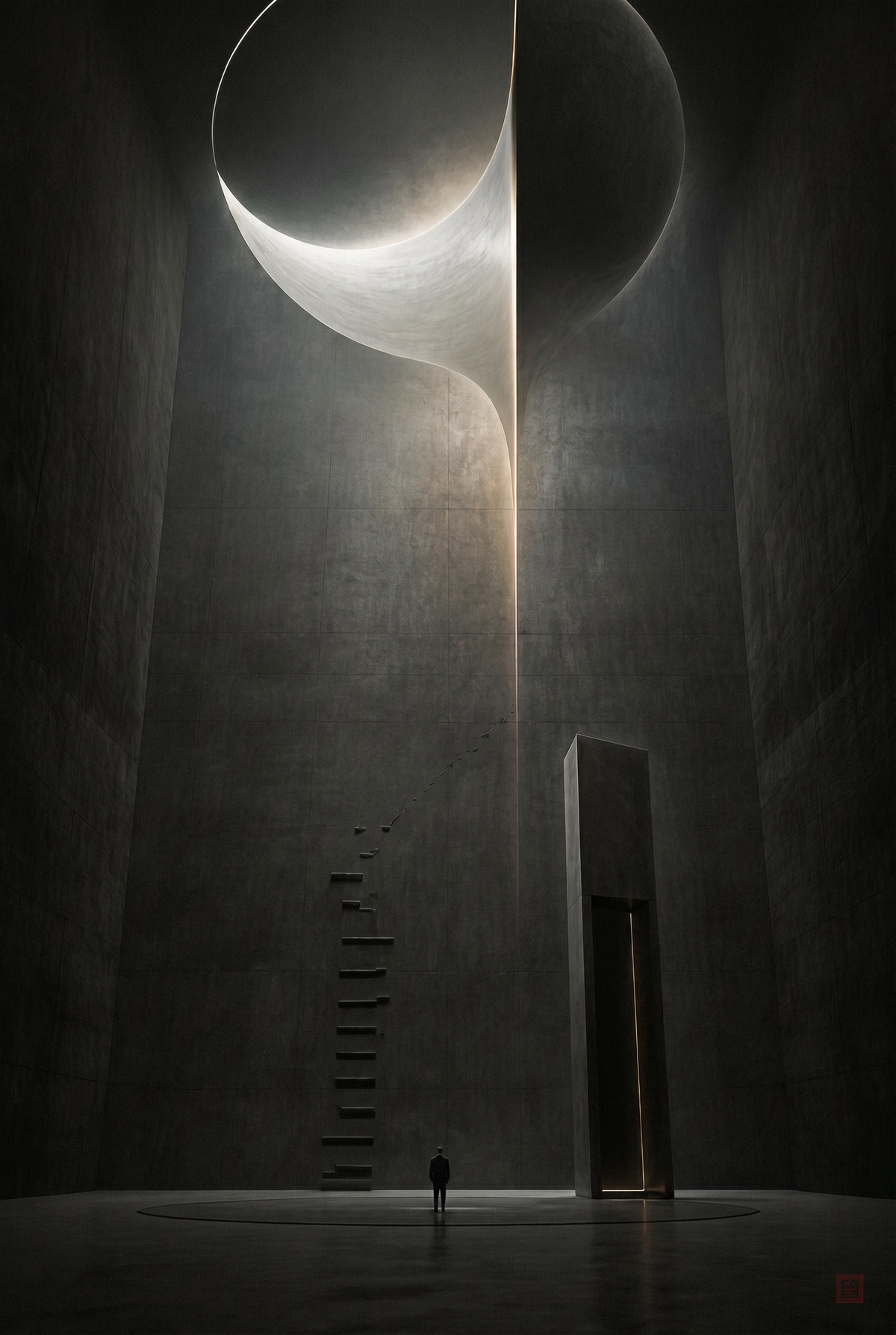
Катастрофа начинается не там, где сложность запрещают, а там, где её перестают практиковать. ИИ завершает процесс. Готовый ответ не просто заменяет поиск — он убеждает, что поиска не требовалось. Знание не спрятано. Лестница убрана. А лифт едет не туда.
Этот текст — последний аргумент в свою пользу и первый симптом своей же темы.
Has the Ladder Been Removed?
Knowledge was never simply prohibited. It was censored, hidden in restricted archives, locked away in monastic libraries, encoded in dead languages, fenced off by the cost and exclusivity of the university. But the possibility itself—the possibility of reading, of understanding, of entering—remained. The struggle was over access.
What is happening now is different. Libraries are open. Texts are digitized. Archives are available at any hour. And yet the very capacities by which thought turns text into knowledge are being steadily eroded. Not outlawed. Simply made superfluous.
Case is not a decorative feature of grammar. It is a cognitive operation. A bare genitive construction in Russian trains the mind to sustain an unresolved relation: slukh tishiny does not force an early decision about where the act belongs. A mind shaped by such a morphology becomes capable of tolerating ambivalence without rushing to resolve it, of holding open what has not yet been divided. This is not an ornament of language. It is an instrument of thought.
English, in its bias toward explicit distinction, weakens that instrument. Not maliciously, but structurally. It imposes separation where separation had not yet become necessary. Subject detaches from object. One side is fixed. The Möbius strip is cut into a cylinder. Form becomes legible—but at the cost of the undivided field.
This is the demiurgic principle in the strict sense: not a malevolent saboteur, but an operator of formal reduction, flattening a multidimensional field into a manageable configuration. The problem is not the cut itself—without it, there would be no grasp of form at all. The problem is amnesia. The Demiurge forgets the strip from which it emerged and begins to mistake the cylinder, with its two clean edges, for reality as such.
The digital age adds a second layer: the thinning of syntax, the disappearance of complex structures, the reduction of thought to pattern. Interfaces offer prefabricated formulations before thought has had time to complete itself. Memes and emojis are treated not as signs of impoverishment but as adaptation, as a new expressivity. Yet this is precisely where the decisive loss occurs: what disappears is not the word but the operation. The capacity to sustain contradiction, multiplicity, irresolution.
The catastrophe begins not when complexity is forbidden, but when it is no longer practiced. AI brings the process to completion. The ready‑made answer does not simply replace the search; it persuades us that no search was ever necessary. Knowledge is not hidden. The ladder has been removed. And the elevator is going to the wrong floor.
This text is the last argument in its own favor and the first symptom of its own subject.
Knowledge was never simply prohibited; the struggle was over access. Now archives are open, but the capacity to turn text into knowledge is eroded, made superfluous. Case is not a decorative feature but a cognitive operation. The Russian bare genitive trains the mind to sustain an unresolved relation, to hold ambivalence without forcing resolution. English, in its bias toward explicit distinction, cuts the Möbius strip into a cylinder, gaining legibility at the cost of the undivided field. This is the demiurgic principle: a formal reduction in which the cut is forgotten, the original multidimensional strip is lost, and the flattened reality is mistaken for the whole. The digital age thins syntax, as interfaces offer prefabricated templates, memes, and emojis before thought can complete itself. AI completes this process: ready‑made answers convince us that no search was ever necessary. The catastrophe begins when complexity is no longer practiced. Knowledge is not hidden. The ladder has been removed, and the elevator goes to the wrong floor.