Потреблядство/Consumerwhorism
Потреблядство
Мат — не падение речи.
Мат нужен там, где обычный язык врёт.
Когда явление слишком грязное — точной остаётся только то, что лицемеры зовут грубостью.
Потреблядство.
Это момент, когда ты перестаёшь жить и начинаешь выставляться.
«Потребление», «общество потребления» лгут своей нейтральностью.
Нужно слово, которое сразу выносит приговор способу существования.
Это не любовь к вещам.
Не слабость к комфорту.
Не бытовая жадность.
Потреблядство — извращённая форма продажности.
Ты добровольно сдаёшь право быть собой и начинаешь жить как товар среди товаров.
Смысл подменяется накоплением форм значимости.
Ты растворяешься — в статусе, в форме, в обладании.
Главное в этом слове — не «потреб-», а «-лядство».
Продажность — подчинение выгоде.
А потреблядство — когда выгода встроена в твои желания, выбор, самооценку.
Ты больше не пользуешься вещью.
Вещь решает, кто ты.
ГДЕ КОНЧАЕТСЯ ПОТРЕБЛЕНИЕ
Потребление — нормально.
Есть. Пить. Одеваться. Строить дом. Покупать инструмент.
В этом нет позора.
Позор начинается там, где вещь перестаёт служить
и начинает судить.
То, что должно помогать, — определяет твою цену.
Ты больше не держишься изнутри — ты собираешь доказательства существования снаружи.
Каждый новый предмет, каждая новая версия жизни — экзамен: достоин ли ты быть?
Если вещь помогает жить — это пользование.
Если она решает, кто ты, — это подчинение.
Желание делает тебя вещью, когда его удовлетворение требует чужого одобрения.
КАК ЭТО РАБОТАЕТ
Сначала создают нехватку.
Потом продают заплатку как спасение.
Потом называют это твоим выбором.
Телефон должен спасти одиночество.
Машина — доказать статус.
Диета — заткнуть ненависть к себе.
Но главный товар — не снаружи.
Тело превращают в проект.
Не чтобы жить — чтобы предъявить.
Биохакинг, фитнес, пластика —
ремонт витрины, за которой пусто.
Заплатка не лечит.
Она делает рану хронической.
Через год — новая модель.
И всё сначала.
Ты выбираешь из того, что тебе подсунули, и называешь это свободой.
Но выбирать между готовыми версиями «я» — не свобода.
Это сборка себя по чужой схеме.
Клетка изнутри выглядит как дом.
ЧУЖОЕ ЖЕЛАНИЕ
Taṇhā — так Будда назвал жажду, которая не насыщается, а размножается.
Бодрийяр сказал: ты входишь в систему заранее сшитых желаний.
Веблен уточнил: расточительство ради взгляда других.
Сегодня конструкторы желаний — алгоритмы, реклама, кредитные стимулы, системы рейтинга.
Они не контролируют тебя напрямую — они калибруют твой голод.
Разные языки — один диагноз: твоё желание тебе не принадлежит.
Ты чувствуешь его как родное — в этом весь трюк.
Настоящий зомби не страшен снаружи.
Он страшен внутри.
Человек с чужой волей, уверенный, что она его.
Он не чувствует укуса.
Он чувствует: «хочу».
Живое.
Личное.
Срочное.
И готов расплатиться собой.
Потреблядство коварнее насилия.
Насилие рождает сопротивление.
Потреблядство рождает соучастие.
Современная власть не требует покорности.
Она вшивает в тебя желания, страхи, критерии.
Ты сам становишься двигателем собственной несвободы.
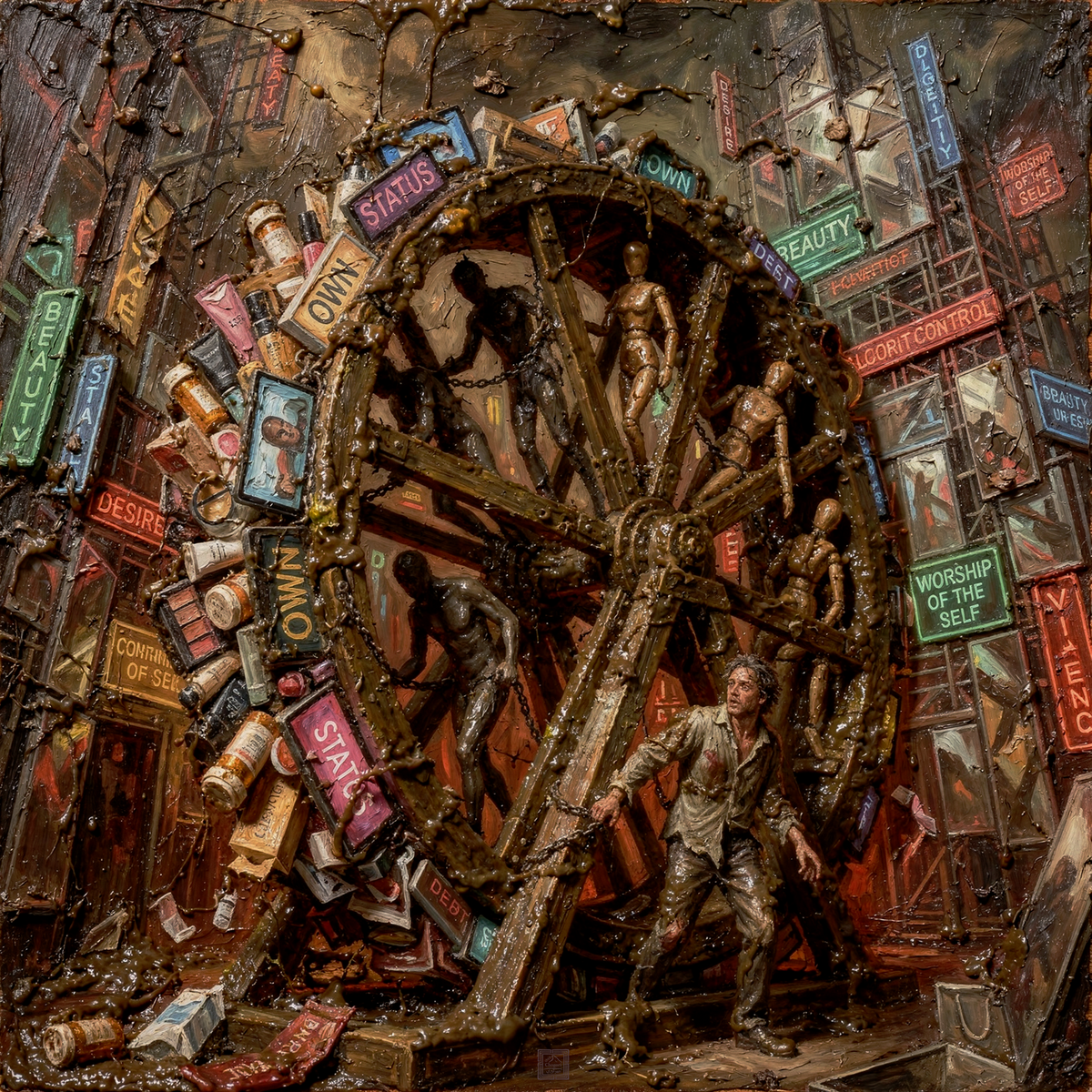
Белка уверена, что бежит вперёд.
Она не видит колеса.
ДОКУПИТЬ СЕБЯ НЕ ВЫЙДЕТ
«Внутренняя ценность» — красиво звучит.
Но кто именно хочет быть ценным?
Разбери это «я» — там мысли, страхи, привычки, образы чужих глаз.
Прочного хозяина нет.
Именно там селится потреблядство.
Оно обещает:
собери,
прокачай,
защити,
продай дороже.
Каждый новый объект обещает завершённость — и приносит лишь отсрочку.
Каждое приобретение глушит пустоту — на пять минут.
Ты не покупаешь вещь.
Ты продаёшь себя.
Тело стареет.
Статус тухнет.
Успех обесценивается.
Потреблядство продаёт то, что невозможно удержать.
А потом продаёт новую версию того же.
И вот тревога:
вдруг ты не дотягиваешь,
вдруг выпал из рейтинга,
вдруг больше нельзя выгодно предъявить.
Страдание перестаёт будить —
его скармливают рынку как топливо.
Купи ещё.
Прокачай ещё.
Оптимизируй ещё.
РАСПРОДАЖА ДОСТОИНСТВА
Всё становится товаром.
Ты узнаёшь об этом не когда покупаешь —
а когда тебя списывают.
Когда вещей мало — начинают потреблять людей.
Коллегу не предают — его утилизируют.
И получают премию.
Друга не теряют — его списывают, как неликвид.
Любовь не заканчивается — её закрывают, как убыточный проект.
Это яма расчеловечивания.
Человек не живёт — он выставляется.
Эмоции — ради эффективности.
Опыт — ради контента.
Жизнь — ради продаж.
Себя.
ВЫХОД
Выход — не в нищете и не в аскезе.
Льняная рубашка за десять тысяч — то же потреблядство, только навыворот.
Осознанное потребление — тот же рынок, только с чувством превосходства.
Zero waste как статус.
Медитация как подписка.
Аскеза как бренд.
Выход — в паузе между импульсом и действием.
Ты смотришь на своё «хочу» и спрашиваешь:
откуда ты пришло?
чьё ты?
Первый честный ответ — «не знаю».
Этого достаточно.
Если твоё — бери.
Если чужое — ты только что вырвал из себя чужой клык.
Это не отказ от вещей.
Это отказ быть вещью.
Система не боится бунта — она его монетизирует.
Система боится тех, кого нельзя купить.
Один человек, вышедший из колеса, опаснее тысячи протестующих —
потому что он доказывает: можно.
Его больше не удаётся убедить, что он недостаточен по каталогу.
Его больше не удаётся продать ему самому.
Рынок всё ещё крутится.
Но тебя больше нельзя купить.
Колесо крутится.
Ты в нём не бежишь.
Consumerwhorism
Profanity is not the collapse of language.
Swearing is needed where ordinary language lies.
When a phenomenon is filthy enough, precision survives only in what hypocrites call vulgarity.
Consumerwhorism.
It begins the moment you stop living and start exhibiting yourself.
“Consumption,” “consumer society” — both lie by sounding neutral.
We need a word that passes sentence on a way of being.
It is not love of things.
Not a weakness for comfort.
Not ordinary greed.
Consumerwhorism is a perverted form of self-sale.
You voluntarily surrender the right to be yourself and begin to live as merchandise among merchandise.
Meaning is replaced by accumulated signs of significance.
You dissolve into status, form, possession.
The core of the word is not “consumer” but “whorism.”
Selling out is submission to profit.
Consumerwhorism is what happens when profit is built into your desires, your choices, your self-worth.
You no longer use the thing.
The thing decides who you are.
WHERE CONSUMPTION ENDS
Consumption is normal.
To eat. To drink. To get dressed. To build a home. To buy tools.
There is no shame in that.
Shame begins where the thing stops serving
and starts judging.
What was meant to help now determines your worth.
You no longer stand from within — you gather external proof that you exist.
Every new object, every new version of life, becomes an exam:
are you worthy to be?
If a thing helps you live, that is use.
If it decides who you are, that is submission.
Desire turns you into a thing the moment its satisfaction depends on the approval of others.
HOW IT WORKS
First they create lack.
Then they sell you a patch as salvation.
Then they call it your choice.
The phone must rescue you from loneliness.
The car must prove your status.
The diet must silence your self-hatred.
But the main commodity is not outside you.
The body is turned into a project.
Not to live — to display.
Biohacking, fitness, plastic surgery —
repairing the storefront. Behind it: emptiness.
The patch does not heal.
It makes the wound chronic.
A year later — a new model.
And it all begins again.
You choose from what has been laid out for you and call it freedom.
But choosing between prefab versions of the self is not freedom.
It is assembling yourself according to someone else’s design.
From the inside, the cage looks like home.
ALIEN DESIRE
Taṇhā — this is the word the Buddha used for a craving that never satisfies itself, only multiplies.
Baudrillard said you enter a system of pre-scripted desires.
Veblen clarified: waste performed for the eyes of others.
Today the engineers of desire are algorithms, advertising, credit incentives, rating systems.
They do not control you directly — they calibrate your hunger.
Different languages, one diagnosis:
your desire is not your own.
You feel it as yours — that is the trick.
The real zombie is not frightening from the outside.
He is frightening within.
A person possessed by an alien will, convinced it is his own.
He does not feel the bite.
He feels: “I want.”
Alive.
Personal.
Urgent.
And ready to pay with himself.
Consumerwhorism is more insidious than violence.
Violence provokes resistance.
Consumerwhorism breeds complicity.
Modern power does not demand obedience.
It stitches desires, fears, and standards into you.
You become the engine of your own unfreedom.
The squirrel is sure it is running forward.
It does not see the wheel.
YOU CANNOT BUY YOURSELF BACK
“Inner worth” sounds beautiful.
But who exactly is it that wants to be worthy?
Take this “I” apart and you will find thoughts, fears, habits, images reflected in the eyes of others.
There is no solid master there.
That is precisely where consumerwhorism makes its nest.
It promises:
gather,
upgrade,
protect,
sell yourself higher.
Every new object promises completion and delivers only delay.
Every acquisition numbs emptiness — for five minutes.
You do not buy the thing.
You sell yourself.
The body ages.
Status rots.
Success depreciates.
Consumerwhorism sells what cannot be kept
and then sells you a new version of the same.
And then comes the anxiety:
what if you are not enough,
what if you fall out of the ranking,
what if you can no longer present yourself at a profit?
Suffering stops waking you up —
it is fed to the market as fuel.
Buy more.
Upgrade more.
Optimize more.
THE CLEARANCE SALE OF DIGNITY
Everything becomes merchandise.
You discover this not when you buy,
but when you are written off.
When there are not enough goods, people themselves become consumable.
A colleague is not betrayed — he is recycled.
And someone gets a bonus.
A friend is not lost — he is written off like dead stock.
Love does not end — it is shut down like an unprofitable venture.
This is the pit of dehumanization.
A person does not live — he displays himself.
Emotion — for efficiency.
Experience — for content.
Life — for sale.
Yourself.
EXIT
The exit is not poverty, and it is not asceticism.
A linen shirt that costs ten thousand is the same consumerwhorism turned inside out.
Conscious consumption is the same market, only with a sense of superiority.
Zero waste as status.
Meditation as subscription.
Asceticism as brand.
The exit lies in the pause between impulse and action.
You look at your “want” and ask:
where did you come from?
whose are you?
The first honest answer is: “I don’t know.”
That is enough.
If it is yours — take it.
If it is alien — you have just torn a foreign fang out of yourself.
This is not a refusal of things.
It is a refusal to be a thing.
The system does not fear revolt — it monetizes revolt.
The system fears those who cannot be bought.
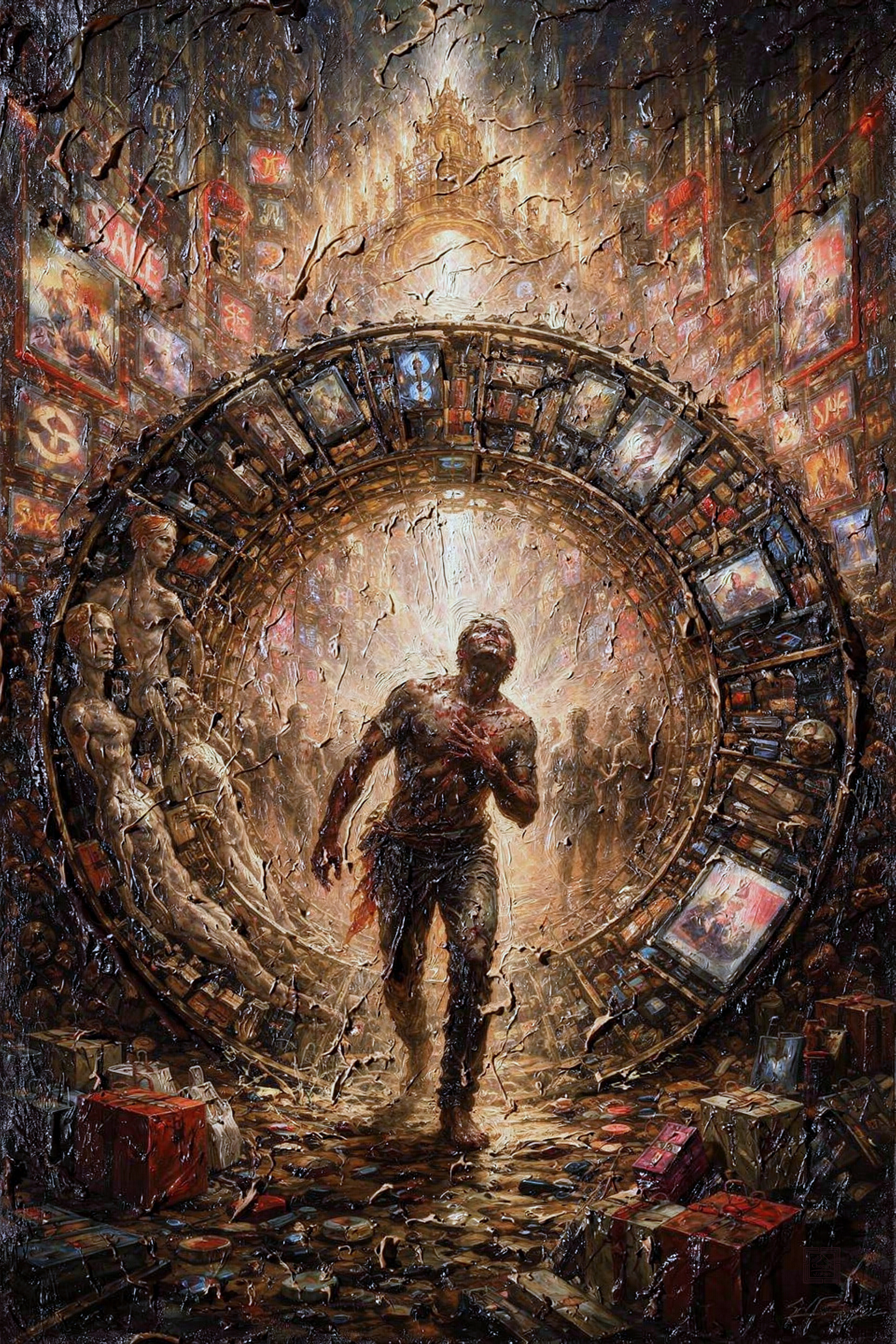
One person who has stepped out of the wheel is more dangerous than a thousand protesters —
because he proves it can be done.
He can no longer be convinced by a catalogue that he is insufficient.
He can no longer be sold to himself.
The market still turns.
But you can no longer be bought.
The wheel turns.
You are in it — and not running.
CONSUMERWHORISM
Profanity is needed where polite language lies. Some realities are too filthy for neutral words. Consumerwhorism begins when you stop living and start exhibiting yourself. It is not simply consumption, comfort, or greed. It is self-sale: the moment things stop serving you and start deciding who you are.
Consumption is normal. Shame begins when worth depends on what you own, display, optimize, and upgrade. The market no longer sells objects — it sells identities, then makes you anxious enough to buy them. Desire is calibrated by ads, algorithms, ratings, and status. You feel it as your own. That is the trick.
Consumerwhorism turns the body into a project, emotion into content, life into a storefront. You do not buy the thing. You sell yourself.
The exit is not asceticism or moral purity. It begins in the pause before obedience: where did this desire come from? Is it mine? Freedom begins when you stop being available for sale.
ПОТРЕБЛЯДСТВО
Ненормативная речь нужна там, где вежливый язык лжёт. Есть вещи слишком грязные для нейтральных слов. Потреблядство начинается, когда ты перестаёшь жить и начинаешь себя показывать. Это не просто потребление, не комфорт и не жадность. Это самопродажа — момент, когда вещи перестают служить и начинают решать, кто ты есть.
Потребление естественно. Стыд начинается там, где ценность зависит от того, что ты владеешь, показываешь, оптимизируешь, обновляешь. Рынок больше не продаёт предметы — он продаёт личности, а затем делает их тревожными, чтобы купить снова. Желание калибруется рекламой, алгоритмами, рейтингами, статусом. Ты чувствуешь его своим. В этом и трюк.
Потреблядство превращает тело в проект, эмоцию — в контент, жизнь — в витрину. Ты не покупаешь вещь. Ты продаёшь себя.
Выход — не в аскезе и не в моральной чистоте. Он начинается в паузе перед послушанием: откуда пришло это желание? Моё ли оно? Свобода начинается там, где тебя больше нельзя купить.