Топология иерархии / The Topology of Hierarchy

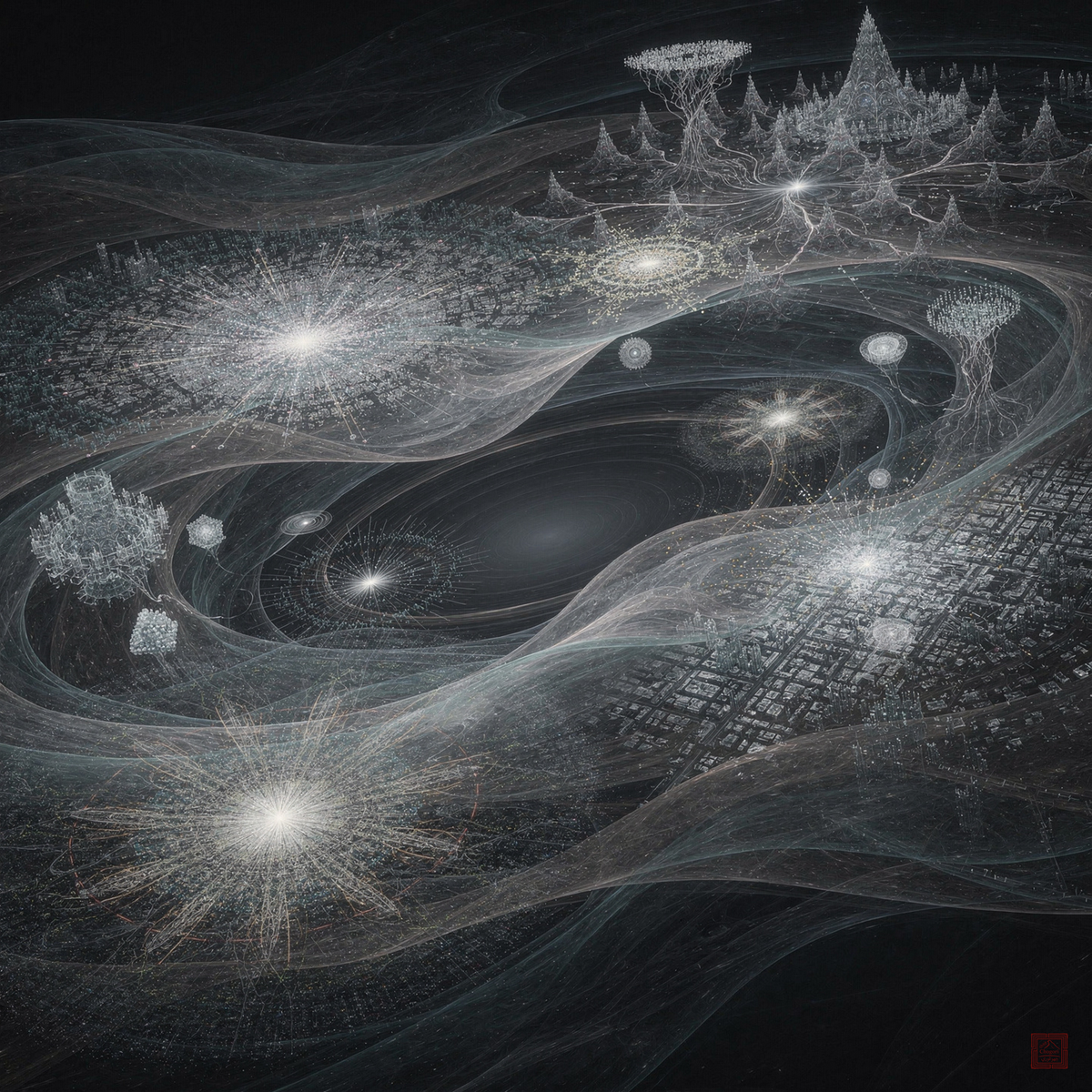
Топология иерархии
Центр, которого нет
Когда мы говорим об иерархии, мы почти всегда представляем пирамиду: власть нисходит с вершины, нижние уровни подчинены верхним, движение приказа и информации направлено сверху вниз. Эта схема настолько привычна, что кажется не образом, а самим определением. Но именно в этом и состоит её обманчивость.
Пирамида описывает не сущность иерархии, а лишь её административную, интерфейсную, наблюдаемую проекцию. Это удобная форма репрезентации, распределения функций и локализации ответственности. В таком режиме иерархия понимается как дискретная вертикаль: каждый уровень видим, каждый связан с вышестоящим, порядок считывается как лестница. Но реальный способ организации — в природе, психике, истории, политике, искусстве, технике и философии — гораздо реже совпадает с этой плоской картиной.
На более глубоком уровне иерархия не пирамидальна, а топологична. Она представляет собой не лестницу, а поле, организованное вокруг центра, который не дан как один из обычных элементов системы. Этот центр не просто скрыт — он недоступен. Его нельзя полностью предъявить, не разрушив саму его функцию. Если бы он был целиком дан, он перестал бы быть центром и стал бы одним из рядоположенных элементов. Центр здесь понимается не как привилегированная вещь, а как источник асимметрии в организации целого. В ряде систем такая недоступность имеет не только эпистемический, но и структурный характер: насильственная экспозиция центра или чрезмерное приближение к нему разрушают тот режим, который он удерживал.
Назовём такой центр организующей сингулярностью. Под этим мы не имеем в виду непременно физическую сингулярность и не утверждаем единой субстанции для всех рассматриваемых случаев. Речь идёт о функциональном полюсе — точке, пороге, разрыве, пустоте, инварианте или режиме различения, — вокруг которого система приобретает форму, не сводя этот полюс к простому объекту среди других объектов. Центр в этом смысле не обязан быть сущностью; достаточно, чтобы он был условием организации. Он не обязательно существует как вещь, но действует как тяготение, как узел структурной необходимости, как принцип селекции возможного.
Иерархию поэтому следует мыслить в двух режимах. Первый — административный: видимая вертикаль ролей, полномочий и подчинения. Второй — топологический: порядок, удерживаемый вокруг недоступного центра. Административная иерархия есть интерфейс топологической. То, что кажется вершиной, нередко оказывается лишь экраном, на который система проецирует своё устройство, скрывая действительный контур причинности.
Этот паттерн повторяется в разных доменах не потому, что между ними можно проводить произвольные метафоры, а потому, что в них вновь и вновь возникает одно и то же различие: между тем, что видно, и тем, что организует; между репрезентацией и причинностью; между явлением и условием явления. Физика знает центры, выводимые по динамике периферии. Химия знает состояния, которые почти невозможно удержать, но которые решают судьбу реакции. Биология знает локальные организаторы глобальной формы. Психология знает центры, не совпадающие с сознательным «я». Политика знает режимы, в которых источник решения отделён от носителя ответственности. Искусство знает формы, организуемые отсутствием, паузой и скрытым полюсом. Кибернетика знает системы, не способные полностью локализовать собственный центр наблюдения. Техника знает интерфейсы, скрывающие реальные условия работы. Философия давно знает, что условие порядка не может быть просто ещё одним элементом порядка.
Но здесь необходимы ограничения. Не всё невидимое является центром. Не всякий центр скрыт намеренно. Не всякая система вообще имеет центр. И не всякая недоступность метафизически глубока. Этот подход не является универсальной отмычкой, объясняющей всё без остатка. Он применим там, где можно показать устойчивую асимметрию между видимой организацией системы и условиями её связности, воспроизводимости или причинной эффективности. Центром в строгом смысле мы будем называть не всё скрытое и не всё причинно значимое, а лишь такой полюс, предел или режим организации, без которого система теряет связность, направленность или воспроизводимость, хотя сам он не сводится к простой сумме наблюдаемых элементов. Центр должен выводиться по эффектам, а не постулироваться по желанию.
Возникает и другое возражение: не возвращаем ли мы тем самым старую метафизику центра, просто заменяя наличное ядро апофатическим? Ответ зависит от различия между онтологическим и функциональным центром. Это эссе не утверждает, что во всех системах существует одна и та же скрытая субстанция. Оно утверждает более строгое и более скромное: многие устойчивые системы организуются вокруг функционального центра, который не может быть полностью предъявлен как элемент собственной структуры. Но в обоих случаях его недоступность не внешняя случайность, а условие организации.
Далее мы попытаемся проследить этот инвариант через разные масштабы реальности и показать: иерархия начинается не там, где есть вершина, а там, где периферия вынуждена организоваться вокруг центра, который не может стать полностью присутствующим.
I. Физика: чёрная дыра и вакуум
В центре галактики Андромеды находится сверхмассивная чёрная дыра M31*. Мы не наблюдаем её как светящееся тело среди других тел. Её присутствие выводится по движениям звёзд, кинематике центральной области, орбитальным и фотометрическим особенностям. Горизонт событий означает не просто тёмную поверхность, а предел извлечения информации в привычном для внешнего наблюдателя смысле.
Чёрная дыра потому и оказывается столь сильной моделью организующего центра, что не предъявляет себя как зрительный объект, но определяет всю конфигурацию вокруг. Более того, в случае Андромеды видимый центр оказывается двусмысленным. Долгое время её ядро воспринималось как двойное: P1 и P2 выглядели как два конкурирующих центра. Но это иллюзия, возникающая из структуры эксцентрического диска: яркость распределяется не там, где находится реальное гравитационное ядро. Система производит видимые центры вокруг центра, который сам остаётся недоступным взгляду.
Если P1 и P2 — сгущения видимости, то M31* — организующее ядро, не совпадающее с ними. Здесь появляется одна из основных формул всего текста: яркость не равна причинности.
Сходный мотив возникает и в квантовой теории поля. Вакуум не есть простое отсутствие. Это фундаментальное состояние поля, относительно которого определяются возбуждения, частицы и взаимодействия. Мы называем его пустотой, но эта пустота продуктивна: именно относительно неё определяются возбуждения, симметрии и сами режимы явления частиц. Вакуум не объект среди объектов, а условие их определимости.
Физика тем самым показывает по меньшей мере два режима недоступного центра: локализованную сингулярность и распределённое фундаментальное состояние. В обоих случаях существенное не обязано быть наблюдаемым как вещь.
II. Химия: переходное состояние
Химия воспроизводит тот же закон в микромасштабе. Решающее в реакции часто принадлежит не самому устойчивому и не самому наблюдаемому её моменту, а тому, что почти невозможно удержать как предмет.
Переходное состояние существует на вершине энергетического барьера и живёт слишком кратко, чтобы стать нормальным веществом. Его нельзя извлечь как устойчивую вещь, но именно оно определяет скорость, возможность и путь реакции. Оно не столько дано, сколько реконструируется: по кинетике, спектроскопическим данным, изотопным эффектам, энергетическим моделям. Центр химического события здесь не совпадает ни с исходными веществами, ни с продуктами; он принадлежит не стабильному бытию, а структурному порогу.
Реакционный центр фотосинтеза показывает ту же логику на уровне пространственной организации. Огромный распределённый аппарат улавливания света существует ради локального события разделения зарядов. Периферия собирает, концентрирует, направляет; но необратимость возникает в малой точке.
Катализатор усиливает этот мотив. Он не господствует над реакцией как внешний суверен, а меняет ландшафт её возможностей: открывает маршрут, снижает барьер, стабилизирует промежуточные конфигурации. В результате он может не остаться как заметный продукт. Он действует, не становясь финальным содержанием события.
Химия показывает, что центр процесса может быть минимален, краток и почти неуловим — и всё же именно он организует всю судьбу превращения.
III. Биология: локальный организатор и многомасштабность
В биологии тот же паттерн становится морфогенетическим. Здесь речь уже не просто о событии, а о форме живого целого.
Организатор Шпемана — малый участок эмбриональной ткани — способен переопределить развитие окружающего материала и инициировать формирование новой оси. Его сила несоразмерна массе. Он не содержит целое в миниатюре, а запускает каскад различий, который собирает целое вокруг локального сигнала.
У общественных насекомых матка тоже не является центром в примитивном смысле командной вершины. Она поддерживает химическое поле колонии, не командуя каждым элементом напрямую. Её роль выявляется не через величие видимости, а через последствия исчезновения. Центр снова познаётся по эффектам.
Фермент даёт почти предельно чистый пример: огромная белковая структура существует ради активного центра — минимальной зоны точнейшего химического действия. Всё остальное выстраивается вокруг него как периферия допуска, ориентации и стабилизации. В буквальном смысле форма строится вокруг функционально решающей малости.
Но биология даёт и важное усложнение. Центральность здесь не всегда единична и неподвижна. Ген, клетка, организм, группа, экосистема — это разные уровни отбора, регуляции и воспроизводства, где организующая функция не обязана совпадать. Иногда то, что стабилизирует элемент, подрывает целое; иногда интерес группы требует подавления локального выигрыша индивида. Следовательно, иерархия жизни не просто централизована: она многомасштабна. Биология показывает не просто наличие центра, а множественность конкурирующих центральностей на разных уровнях.
Жизнь тем самым показывает: организующее не обязано быть ни самым большим, ни самым видимым, ни самым автономным.
IV. Психология: центр без субстанции
В психологии различие между видимым и действительным центром становится внутренним.
Юнг различал эго и Самость. Эго — центр сознания; Самость — центр психики в целом. Поэтому Самость не может быть просто предъявлена сознанию как один из объектов опыта: она структурно шире поля, в котором действует эго. Она узнаётся по косвенным следам — через сновидения, симптомы, повторения, архетипические фигуры, внутренние смещения.
Современная динамическая теория психики говорит об аттракторах и ландшафтах устойчивости. Поведение организуется не потому, что внутри субъекта сидит маленький командный агент, а потому, что пространство возможного структурировано неравномерно. Центр здесь не субстанция, а режим тяготения.
Деннет радикализует это в понятии «центра нарративной гравитации». Личность может быть реальной не как скрытая вещь, а как виртуальный центр связности рассказа. Это важно для общей темы: реальность центра не всегда вещественна. Иногда то, что удерживает множественность в единстве, существует как структурный эффект, а не как скрытое ядро-субстанция.
Здесь особенно продуктивна и лакановская перспектива. Недоступный центр — это не просто тайное содержание, скрытое за символическим порядком, а то, что сопротивляется полной символизации и именно поэтому организует поле как его разрыв, дефицит и навязчивое возвращение. Реальное в лакановском смысле не стоит «позади» знаков как готовая сущность; оно проявляется как невозможность полного замыкания символического. Центр тем самым обнаруживает себя не только через гармонию, но и через симптом, сбой, повторение, травматическое возвращение того, что не удаётся окончательно оформить.
Психология тем самым предохраняет всю модель от наивной онтологизации: центр может быть реальным, не будучи вещью; а его недоступность может выражаться не в тайне содержания, а в невозможности полной символизации.
V. Политика: ложные центры, ответственность и предел разоблачения
В политике различие между видимостью и причинностью становится исторически драматичным, потому что здесь к организации добавляются легитимация и ответственность.
Фигура серого кардинала слишком часто понимается психологически: как хитрый человек, спрятавшийся в тени. Но политически существеннее другое. Устойчивый порядок не может полностью совместить в одной точке источник решения, поверхность легитимации и носителя ответственности. Такая перегрузка разрушила бы форму власти. Поэтому система почти неизбежно разводит эти функции.
Видимый правитель, кабинет, партия, парламент или лидер в этом смысле выступают интерфейсами. Они несут ритуал, символическую экспозицию, публичное обвинение и ожидание. Но реальный контур решений может быть смещён в менее видимую область. Невидимость здесь не только стратегия субъекта, а морфологическая необходимость. Патология власти начинается там, где административная вершина требует признать себя топологическим центром.
При этом сам кардинал не должен романтизироваться как абсолютный хозяин истории. Его воля уже предструктурирована аппаратом, традицией, институциональной памятью, распределением допустимого. Он занимает место, которое система заранее открыла как необходимую пустоту между репрезентацией и причинностью. Не человек создаёт тень власти; власть создаёт человека как её носителя.
Здесь гностическая интуиция получает историческую форму. Демиургом может быть не персонаж, а сама инерция оформленного порядка: аппарат, матрица решений, институциональная машина, исторически затвердевшая логика мира. Лица власти — лишь маски этой функции. Они относятся к власти так же, как P1 и P2 к M31*: как видимые сгущения, ошибочно принимаемые за источник того, что они только проявляют.
Но важнее другое: разоблачение ложного центра почти никогда не уничтожает саму структуру. Когда разоблачён монарх, возникает суверенный народ; когда разоблачён папа, возникает чистая вера; когда разоблачена аристократия, возникает безличный аппарат; когда разоблачён аппарат, возникает рынок, экспертность, безопасность, данные. Система способна переживать разоблачение, потому что нуждается не в конкретной маске, а в самой функции центра видимости. Это и есть предел разоблачения: можно сорвать маску, но тем самым часто лишь заставляешь структуру произвести новую.
Есть и более жёсткая формулировка той же логики: в некоторых политических режимах чрезмерное приближение к реальному центру решения или его прямая экспозиция не открывают истину власти, а разрушают саму конфигурацию, в которой эта власть могла действовать. Названный вслух скрытый посредник перестаёт быть посредником; выведенная на сцену тень теряет морфологическую функцию тени. Поэтому недоступность центра здесь нередко есть не просто защита секрета, а условие работоспособности самой структуры.
Из этого следует практический вопрос: возможна ли здоровая политическая иерархия? По-видимому, да — но только при условии, что административный уровень не претендует на полное совпадение с топологическим. Здоровая структура не обещает абсолютной прозрачности там, где она невозможна, не смешивает легитимацию, причинность и ответственность в одном фетише, не превращает интерфейс власти в метафизический идол. Она признаёт необходимость символического центра, но не обожествляет ни одну его маску.
Политика тем самым показывает не только скрытость центра, но и историческое воспроизводство ложных центров, а также необходимость различать между тоталитарной фантазией полного совпадения центра с видимостью и зрелым признанием неизбежного люфта внутри всякой организованной формы.
V.a. Семиотика: знак и бесконечный семиозис
Между политикой и эстетикой располагается домен, который, пожалуй, наиболее чисто воспроизводит структуру недоступного центра: семиотика — наука о знаке как таковом.
Знак, по Пирсу, существует в трёхчленном отношении: репрезентамен (носитель знака), объект (то, о чём знак) и интерпретант (то, во что знак разворачивается в следующем акте понимания). Объект знака не дан напрямую — к нему всегда обращаются через интерпретант, который сам становится знаком, порождая следующий интерпретант. Это и есть бесконечный семиозис: не дефект системы и не логический порок, а структурное свойство. Финальный объект — «динамический объект» в пирсовском смысле — остаётся организующим пределом цепи: он направляет весь процесс, оставаясь недостижимым как конечная позиция.
В этом смысле знак устроен именно так, как устроены все рассматриваемые нами системы. Организующее начало (динамический объект) не совпадает ни с одним из явленных звеньев цепи. Оно выводится по движению интерпретантов — так же, как чёрная дыра выводится по движению звёзд, а переходное состояние — по кинетике реакции.
Лакановский Реальный объект — objet petit a — добавляет к этому психодинамику. Это не скрытое содержание за означающим, а то, что сопротивляется полной символизации и именно поэтому удерживает желание в движении. Означающая цепь организуется вокруг пустоты, которую заполнить означало бы уничтожить само желание. Здесь центр — не тайна, которую можно раскрыть, а структурная невозможность закрытия.
Деррида описывает ту же ситуацию в терминах différance: означаемое всегда отсрочено и смещено, никогда не предъявлено как чистое присутствие. Три версии — пирсовская, лакановская, деррианская — сходятся в одном: знак организован вокруг центра, который не может быть дан как элемент собственной цепи. Язык есть система, в которой организующий предел конститутивно отсутствует среди того, что он организует. Это не патология языка, а условие его работы.
Семиотика тем самым показывает: недоступный центр — не особенность физических или биологических систем. Он встроен в саму возможность означения. Там, где возникает знак, возникает и структурное отсутствие полного объекта.
VI. Эстетика: форма и испытание без центра
Искусство знает этот паттерн как опыт формы. Но именно здесь необходимо испытание: что происходит там, где центр пытаются устранить намеренно?
В тональной музыке центр очевиден как полюс тяготения: тоника не обязана постоянно звучать, чтобы организовывать всю систему функций. Пауза, метр, композиционный баланс и умолчание работают сходным образом: организующее не обязано быть непосредственно данным.
Но XX век пытается подорвать эту модель. Серийная и посттональная музыка намеренно уничтожает традиционный тональный центр. На первый взгляд это контрпример. Однако именно здесь проявляется важная вещь: либо система действительно распадается на однородную последовательность, утрачивая чувство направления, либо порождает новые локальные, временные, тембровые, ритмические, регистровые или формальные центры. Модернизм важен не тем, что уничтожил центр, а тем, что показал цену его утраты.
Точно так же в живописи композиционный центр может не совпадать ни с геометрическим центром, ни с самой яркой фигурой. Его может задавать отрицательное пространство, ось напряжения, баланс масс. В литературе текст может организовываться вокруг умолчания, отсутствующего события или вытесненного мотива. В театре и кино пустой кадр, пауза, off-screen пространство нередко структурируют внимание сильнее, чем то, что помещено в непосредственную видимость.
Эстетика потому особенно важна, что она не только демонстрирует скрытый центр, но и проверяет возможность мира без него. И всякий раз выясняется: либо возникает новый функциональный центр, либо форма начинает терять связность. Искусство может бунтовать против центра; форма — почти никогда.
VI.a. Насильственная экспозиция: когда приближение разрушает режим
Этот тезис был введён в предисловии и зафиксирован в тринадцатом положении синтеза, но ни в одном из предшествующих разделов он не был развёрнут систематически. Между тем это один из наиболее неочевидных и потенциально наиболее сильных аргументов всего текста. Речь не о том, что центр скрыт и его трудно увидеть; речь о том, что в ряде систем приближение к нему или его прямая экспозиция не открывает истину организации, а разрушает сам режим, который этот центр удерживал.
В квантовой механике измерение — не нейтральное наблюдение. Акт фиксации значения переменной коллапсирует суперпозицию и тем самым уничтожает ту структуру неопределённости, которая была операционально реальной до измерения. «Центр» — квантовое состояние системы — не просто становится известным в акте измерения; он прекращает существовать в прежнем режиме. Знание достигается ценой уничтожения того, что знание искало.
В психоаналитической практике это знакомо как судьба сопротивления при прямом форсированном толковании. Если аналитик называет вытесненное содержание прямо, без достаточной проработки переноса, пациент нередко не приходит к прояснению, а уходит в интеллектуализацию, отрицание или разрыв. Центр психического конфликта требует не экспозиции, а постепенного приближения через обходные маршруты — сновидения, оговорки, ассоциации. Прямое обнажение работает против терапевтического режима именно потому, что разрушает защитную конфигурацию, удерживавшую систему в рабочем состоянии.
В полевой антропологии эффект наблюдателя проявляется иначе, но по той же логике. Присутствие наблюдателя меняет исследуемый порядок: ритуал, исполняемый перед записывающей камерой, уже является иным ритуалом. Центр практики — коллективный, телесный, неотрефлектированный — изменяется под давлением наблюдающего взгляда. Попытка полностью «вскрыть» структуру сдвигает саму структуру. Более острый случай: когда антрополог делает скрытые нормы видимыми самим участникам, он нередко запускает процесс их трансформации или утраты. Экспозиция центра действует на него.
В политике это уже было отмечено: скрытый посредник, названный вслух, теряет морфологическую функцию посредника. Разоблачённая тень перестаёт быть тенью; но это означает не исчезновение функции, а её переброс на другого носителя.
Все эти случаи структурно едины. Центр не просто труднодоступен; он в ряде конфигураций удерживается именно тем, что к нему не подходят вплотную. Дистанция — не просто эпистемический дефицит, а онтологическое условие самого режима. Тогда экспозиция — это не разоблачение скрытого; это интервенция в живую структуру. И потому мышление об организующем центре требует не только аналитической проницательности, но и особого рода осторожности: вопрос «как устроен этот центр» нельзя полностью отделить от вопроса «что произойдёт с ним в момент ответа».
VII. Математика: когда сингулярность структурно необходима
Математика позволяет не просто иллюстрировать, а уточнять общий тезис. Она показывает, что особые точки, инварианты и режимы устойчивости возникают не как дефекты описания, а как следствия формы самой системы.
Полюса функций, неподвижные точки, инварианты и аттракторы задают режимы, в которых поведение целого определяется не равномерным вкладом всех элементов, а особыми структурами устойчивости. Особенно показателен странный аттрактор: хаотическая динамика не лишена организации, а удерживается сложным полем тяготения, которое нельзя свести к простой геометрической вершине. Уже здесь видно: центр не обязан быть точкой в пространстве; он может быть структурой, задающей область допустимого поведения.
Ещё важнее топологический случай. Теорема о причёсывании ежа утверждает, что на сфере невозможно задать непрерывное касательное векторное поле без хотя бы одной сингулярности. Это означает, что существуют такие формы целого, которые не могут быть глобально организованы без особой точки. Но из этого не следует универсальность центра как такового: на торе непрерывное поле без сингулярностей возможно. Следовательно, центр не есть необходимость всякой структуры; он есть необходимость некоторых морфологий. И именно это важно для нашей темы: вопрос о центре зависит не от привычки мышления, а от формы самой связности.
Математика тем самым показывает две вещи. Во-первых, сингулярность может быть структурно необходимой. Во-вторых, центр следует мыслить не только геометрически, но и формально.
VIII. Кибернетика: наблюдение второго порядка и слепое пятно центра
Кибернетика второго порядка делает проблему центра особенно строгой, потому что переносит её в сам акт наблюдения. Если классическая кибернетика описывает управление и обратную связь, то кибернетика второго порядка спрашивает: что происходит, когда система включает в описание собственные операции различения?
Система может наблюдать мир лишь постольку, поскольку проводит различие между собой и средой, сигналом и шумом, релевантным и нерелевантным. Но как только она начинает наблюдать собственное наблюдение, возникает структурная трудность, по-разному описанная у фон Фёрстера, Лумана и Спенсер-Брауна: условие различения не может быть полностью схвачено внутри того, что оно само делает различимым. Всякая попытка локализовать центр наблюдения порождает новое слепое пятно.
Именно в этом смысле re-entry — повторное вхождение различия в само себя — не устраняет асимметрию, а воспроизводит её на новом уровне. Наблюдатель может сделать собственные операции предметом анализа, но не может без остатка устранить позицию, из которой этот анализ ведётся. Центр наблюдения не исчезает; он отступает.
Отсюда следует общий вывод: самонаблюдающая система не способна полностью сделать прозрачными условия собственной прозрачности. Чем сильнее она стремится к полному учёту, тем более значимыми становятся невидимые фильтры, протоколы, схемы кодирования и критерии отбора, благодаря которым этот учёт вообще возможен. Прозрачность не отменяет скрытого центра; она производит его на более глубоком уровне.
Кибернетика тем самым показывает, что недоступный центр — это не метафизическая роскошь, а структурное свойство всякой системы, которая пытается наблюдать саму себя.
IX. Технология и ИИ: интерфейсная личность и распределённый центр
Современные технические системы, прежде всего искусственный интеллект, делают различие между интерфейсом и центром особенно наглядным. Пользователь взаимодействует с собеседником: с голосом, стилем, памятью контекста, кажущейся последовательностью реакций. На поверхности возникает субъектоподобное поведение. Но эта поверхность не указывает на единое внутреннее «я» в классическом смысле.
Поведение модели организуется множеством уровней: архитектурой, статистическим распределением весов, функцией потерь, данными обучения, процедурами выравнивания, фильтрами, системными ограничениями и инфраструктурой развёртывания. Ни один из этих компонентов не является субъектом, но вместе они образуют причинную конфигурацию, которая производит устойчивый интерфейс личности. ИИ тем самым делает видимым субъектоподобное поведение без локализуемого субъекта.
Особенно важно, что интерфейс здесь может быть гораздо более цельным, чем его реальная причинная организация. Чем более гладкой, полезной и персонализированной становится поверхность взаимодействия, тем труднее увидеть распределённые условия, которые её поддерживают.
В этом смысле современная техника не уничтожает скрытый центр, а меняет его форму. Центр становится не личностью и не сувереном, а распределённой архитектурой селекции. Интерфейс обещает близость и понятность; причинная структура остаётся частично непрозрачной. Именно поэтому проблема согласования поведения системы с её глубинными режимами оптимизации столь показательна: она касается не просто настройки ответов, а отношения между интерфейсом и причинной архитектурой.
Технологическая эпоха тем самым радикализует общий тезис: чем совершеннее интерфейс, тем менее очевиден центр, который организует его действие.
X. Философия: от недоступного центра к мышлению как его симптому
Философия давно знала, что условие порядка не может быть просто ещё одним элементом порядка. У Аристотеля неподвижный двигатель движет, не будучи одним из движущихся тел; у Платона Благо находится по ту сторону бытия; у Плотина Единое выше бытия и мышления; у Канта трансцендентальное единство апперцепции не есть одно из представлений; у Хайдеггера Бытие не является сущим. Во всех этих случаях мысль сталкивается с тем, что организующее не совпадает с тем, что организовано.
Но современная философия вносит сюда решающее уточнение: недоступный центр нельзя безоговорочно превращать в скрытую субстанцию. У Деррида центр структуры парадоксален именно потому, что должен одновременно принадлежать структуре и не принадлежать ей. Если он полностью наличен, он становится одним из элементов игры; если полностью вынесен вовне, он перестаёт быть центром этой игры. Différance поэтому важна не как отрицание центра, а как указание на то, что организующее может действовать через отсрочку, различение и смещение, а не через наличную сердцевину.
Буддийская шуньята радикализует эту предосторожность. Пустота означает не тайное ядро за явлениями, а отсутствие самосущей основы у всякой вещи. Это не уничтожает проблему центра, а лишает её грубой субстанциальности: центр может быть действенным, не будучи вещью. Даосская мысль выражает это почти технически: полезность колеса — в пустоте ступицы, полезность сосуда — в его полости. Здесь пустота не противостоит форме; она делает форму возможной.
Здесь, однако, возникает напряжение, которое не следует скрывать: центр может мыслиться либо как несводимое отсутствие, либо как аттрактор, задающий направленность формы. Мы не снимаем это напряжение окончательно. Скорее, оно указывает на двойственный характер организующего предела, который одновременно ускользает от наличности и структурирует поле возможностей.
Гностическая интуиция позволяет, в свою очередь, различить исток и оформленный порядок. То, что организует видимый мир, легко узурпирует место абсолютного основания. Ложный центр оказывается не просто эпистемической ошибкой, а структурной маской порядка. Эта идея имеет не только религиозный, но и историко-политический смысл: система почти неизбежно стремится выдать интерфейс организации за её окончательный источник.
Если гностическая интуиция настаивает на различии между высшим истоком и устроением мира, то это различие не следует мыслить как противостояние двух равномощных начал. Исток остаётся одним. Монада, Дао, предельная Нирвана, Абсолют не имеют симметричного себе противостояния; всё, что возникает как разделение, отпадение, замыкание и борьба, принадлежит уже не уровню первоначала, а порядку проявления. Поэтому демиургическое не образует самостоятельного метафизического центра: оно есть лишь ограниченный режим организации, в котором целое дано в форме разрыва, опосредования и частичной утраты истока. В этом смысле нирвана и сансара суть не два независимых мира и не два онтологических суверена, а полярности одного и того же развёртывания, различимые лишь внутри той перспективы, где единство уже преломлено в множественность. Мораль тогда оказывается не автономным кодексом и не внешней надстройкой над миром, а знаком того, что замкнутый порядок никогда не замкнут окончательно: в нём сохраняется проницаемость для иного измерения. Если воспользоваться гностическим языком, мораль есть не просто нормативная регуляция внутри космоса, но одно из выражений проникновения Плеромы в демиургическую ткань мира.
Тем самым анализ выходит за пределы эмпирического описания и переходит в собственно метафизическую плоскость. Если организующее начало не совпадает ни с одной из своих манифестаций, то вопрос теперь состоит не в том, где его локализовать, а в том, каким образом оно действует в самом порядке явленности, не становясь при этом одним из её элементов. Здесь философия обнаруживает предел всякой позитивной онтологии: источник порядка не может быть предъявлен как вещь, субстанция или объект среди объектов, поскольку именно он делает возможным само различие между данным и его условием.
Если недоступный центр не просто организует системы, но и оставляет след в самой возможности мышления, тогда сознание нельзя понимать как замкнутую собственность отдельного субъекта. Мысль приходит к нам не только как инструмент, которым мы свободно пользуемся, но и как требование различать, связывать и доводить явленное до формы. В этом смысле мышление можно понять как один из симптомов того, что бытие стремится к собственному прояснению через конечные формы сознания.
Тогда самопознание оказывается не частным психологическим актом, а событием более глубокого порядка. Мы ищем исток не только потому, что задаёмся вопросами; мы задаёмся вопросами потому, что исток, оставаясь недоступным, уже действует в нас как требование мысли. Центр не становится объектом, но заставляет периферию организовываться вокруг него в форме знания, языка, символа, науки и философии.
Отсюда следует и новое понимание рациональности. Научное мышление, основанное на различении, анализе и формализации, не следует противопоставлять недвойственным или апофатическим формам постижения как простую ошибку против истины. Напротив, оно есть один из способов, которыми бытие расчленяет собственную явленность и делает её доступной закону, числу, структуре и действию. Но именно поэтому рациональность нуждается в тех традициях — апофатических, буддийских, даосских, созерцательных, — которые напоминают: различение не исчерпывает целого и не тождественно истоку различимого.
Апофатичность истока не отменяется космистской перспективой. Меняется лишь регистр: недоступное мыслится уже не только как разрыв, предел и несводимость, но и как то, что может действовать в истории и мышлении в режиме тяготения, собирания и преобразующего импульса.
Русский космизм придаёт этой мысли исторический и космический масштаб. У Вернадского мысль становится ноосферным моментом самоорганизации материи; у Циолковского разум выступает как стадия космической эволюции; у Фёдорова самосознание мира требует уже не только понимания, но и преобразующего общего дела. Если принять эту перспективу, человеческое мышление перестаёт быть частной функцией индивида и становится одним из способов, которыми мир приходит к различённому самопознанию.
Философия тем самым доводит общий тезис до предела: центр может быть необходим, не будучи наличной сущностью; его недоступность может быть не дефектом знания, а формой самой организации; а мышление — не только исследованием этого центра, но и одним из способов его действия в мире.
Именно поэтому физика, химия, биология, психология, политика, техника и философия были рассмотрены здесь не как набор разнородных примеров. Во всех этих областях обнаруживается одно и то же структурное отношение: организующее начало не совпадает с собственной явленностью и открывается лишь в опосредованной форме — через эффекты, пороги, асимметрии, смещения и конфигурации наведённого порядка. Повторяемость этого отношения в различных регистрах реальности указывает не на внешнее сходство описаний, а на действие единого принципа, который развёртывается в разных масштабах сущего, не исчерпываясь ни одним из них. То, что далее будет сведено в ряд тезисов, представляет собой не перечень частных наблюдений, а попытку формально зафиксировать именно этот инвариант.
Диаграмма режимов центральности
Различные рассмотренные домены распределяются по двум осям. Первая: локализованность центра в пространстве системы — от точечно-локализованного до полностью распределённого. Вторая: тип недоступности — от принципиальной (структурная невозможность полной экспозиции) до технической (непрозрачность, устранимая методически, хотя бы в принципе).
|
Домен |
Центр |
Локализованность |
Тип недоступности |
|
Физика
(чёрная дыра) |
Гравитационная
сингулярность M31* |
Локализован |
Принципиальная
(горизонт событий) |
|
Физика
(вакуум КТП) |
Фундаментальное
состояние поля |
Распределён |
Принципиальная
(не объект среди объектов) |
|
Химия
(переходное состояние) |
Вершина
энергетического барьера |
Локализован |
Принципиальная
(время жизни слишком мало для прямой фиксации) |
|
Биология
(организатор Шпемана) |
Локальный
морфогенетический сигнал |
Локализован |
Техническая
(поддаётся экспериментальному доступу) |
|
Биология
(фермент) |
Активный
центр белка |
Локализован |
Техническая
(структурная биология, моделирование) |
|
Биология
(многомасштабность) |
Конкурирующие
уровни отбора |
Распределён |
Принципиальная
(нет единой точки центра) |
|
Психология
(Самость по Юнгу) |
Центр
психики в целом |
Распределён |
Принципиальная
(структурно шире поля эго) |
|
Психология
(objet petit a) |
Организующая
пустота желания |
Нелокализуем |
Принципиальная
(сопротивляется символизации) |
|
Политика
(серый кардинал) |
Скрытый
контур решения |
Частично
локализован |
Смешанная
(личностная тайна + структурная необходимость) |
|
Политика
(институциональная инерция) |
Матрица
допустимого |
Распределён |
Принципиальная
(нет индивидуального носителя) |
|
Семиотика
(динамический объект) |
Предел
семиозиса |
Нелокализуем |
Принципиальная
(никогда не становится элементом цепи) |
|
Эстетика
(тональный центр) |
Тоника как
полюс тяготения |
Локализован
функционально |
Техническая
(выявим из контекста) |
|
Эстетика
(отрицательное пространство) |
Организующее
отсутствие |
Распределён |
Техническая
(анализ композиции) |
|
Математика
(аттрактор) |
Структура
области притяжения |
Распределён |
Техническая
(вычислима или аппроксимируема) |
|
Математика
(теорема о ежe) |
Структурная
необходимость сингулярности |
Не точка,
а морфология |
Принципиальная
(следствие топологии сферы) |
|
Кибернетика
(re-entry) |
Условие
различения наблюдателя |
Нелокализуем |
Принципиальная
(отступает при рефлексии) |
|
Технологии
и ИИ (архитектура модели) |
Распределённые
веса и протоколы обучения |
Распределён |
Техническая
(частично прояснима интерпретацией) |
|
Философия
(трансцендентальное единство) |
Условие
возможности опыта |
Нелокализуем |
Принципиальная
(не одно представление среди других) |
Таблица обнаруживает то, что однородное изложение скрывало. Домены правого нижнего угла (технически непрозрачный и распределённый) — прежде всего ИИ и некоторые политические случаи — принципиально отличаются от доменов, где недоступность структурна. Смешение этих режимов в рамках единого тезиса об организующей сингулярности создаёт видимость однородности там, где реально есть семейство различных случаев.
Это не разрушает общий аргумент, но уточняет его применимость. Строгий тезис звучит так: организующая сингулярность в полном смысле — с принципиальной недоступностью — реализуется там, где центр нелокализуем структурно, а не только методически. Случаи технической непрозрачности образуют пограничную зону: они демонстрируют ту же морфологию поверхностно, но не воспроизводят глубинного условия. Осознание этого различия не ослабляет аргументацию — оно делает её точнее.
XI. Синтез: тринадцать тезисов
1. Там, где иерархия действительно складывается, она имеет по меньшей мере два режима: административный и топологический.
2. Видимая вершина не обязана совпадать с реальным центром организации.
3. Центр чаще выводится по эффектам, чем даётся напрямую.
4. Его реальность может быть не субстанциальной, а функциональной.
5. Недоступность центра нередко является условием его организующей роли.
6. Системы склонны производить ложные центры — яркие, публичные, легитимные.
7. Разоблачение ложного центра обычно не уничтожает структуру, а вынуждает её создать новую маску.
8. Не всякая система требует сингулярности, но некоторые формы целого не могут обойтись без неё.
9. Центральность может быть многомасштабной и распределённой между конфликтующими уровнями.
10. Самонаблюдающие системы не могут полностью локализовать условие собственного наблюдения.
11. Технологическая современность не устраняет скрытый центр, а умножает его интерфейсы.
12. Мышление не только ищет недоступный центр, но и само возникает как форма его непрямого действия.
13. В некоторых системах приближение к центру или его полная экспозиция не проясняют организацию, а разрушают сам режим, который этот центр удерживает.
Заключение: иерархия как самораскрытие недоступного
Мы почти никогда не имеем дело с центром напрямую. Мы имеем дело с его следами, масками, интерфейсами, заместителями и эффектами. Мы видим сгущения и принимаем их за ядро; слышим звучащее и пропускаем паузу; наблюдаем правителей и не замечаем матрицу допустимого; держимся за эго и не знаем более глубокой организации психики; пользуемся техническими системами, не имея доступа к архитектуре их действительной причинности. Но это не просто ошибка восприятия. Это свойство самих структур, которым для устойчивости необходимо разводить причинность и видимость.
Если центр действительно организует, он не может быть полностью дан как ещё один элемент. Его полная экспозиция означала бы его редукцию. В ряде случаев она означала бы и нечто большее: разрушение самого режима, который он удерживал. Поэтому недоступность центра есть не только ограничение наблюдения, но и, нередко, условие его действия. И потому вопрос о порядке не сводится к вопросу «кто наверху?». Это вопрос административной поверхности. Более точный вопрос таков: что организует поле, какие маски оно производит, почему его ядро не может быть предъявлено без остатка и что происходит, когда к нему пытаются подойти слишком близко?
Но на этом мысль не останавливается. Если сам акт мышления уже есть симптом действия недоступного центра, тогда и вопрос об иерархии перестаёт быть внешним описанием устройства мира. Он становится моментом самого процесса, в котором бытие пытается прояснить себя через конечные формы сознания. Мы ищем центр не только потому, что хотим понять мир; мы ищем его потому, что в мышлении мир впервые становится местом, где его собственная непрозрачность начинает работать против самой себя. Самопознание в таком смысле есть не психологическая роскошь и не случайная культурная практика, а один из способов, которыми исток, не являясь непосредственно, оставляет след в истории, науке, символе, искусстве, политике, технике и мышлении.
Рациональность здесь не враг истока, а его орудие различения. Недвойственные и апофатические формы мысли не враг знания, а память о том, что различение не исчерпывает целого. Вернадский, Циолковский, Фёдоров и другие космисты позволяют увидеть в этом не только метафизическую, но и историко-космическую перспективу: мысль есть не частное свойство индивида, а стадия самоорганизации мира, планетарный и, возможно, космический орган рефлексии. Технологическая эпоха, вопреки ожиданию, не отменяет этого, а лишь умножает новые интерфейсы недоступного. Значит, в нашем мышлении исток не просто отражается — он работает.
Именно поэтому иерархия в строгом смысле начинается не там, где есть вершина, а там, где существует недоступный центр, вокруг которого организуется периферия и под действием которого она ищет собственный исток.
Иерархия — это не пирамида.
Иерархия — это топология недоступного.
И, быть может, мысль — тот предел, на котором недоступное впервые становится различимым как недоступное.
The Topology of Hierarchy
The Center That Is Not There
When we speak of hierarchy, we almost automatically picture a pyramid: power descending from above, lower levels subordinated to higher ones, commands and information flowing downward. The image is so familiar that it no longer feels like an image at all, but like the very definition of hierarchy. That is exactly what makes it misleading.
The pyramid does not capture the essence of hierarchy. It captures only its administrative and representational surface—its outward, visible form. It is a convenient scheme for distributing functions, assigning roles, and locating responsibility. On this view, hierarchy appears as a discrete vertical order: each level visible, each linked to the one above it, the whole readable as a ladder. But the deeper logic of organization—in nature, psyche, history, politics, art, technology, and philosophy—far more rarely conforms to so flat a model.
At a deeper level, hierarchy is not pyramidal but topological. It is not a ladder but a field organized around a center that does not appear as one ordinary element among others. This center is not simply hidden; it is inaccessible. It cannot be fully brought into view without undoing the function it performs. If it were fully present, it would cease to be a center and become just another element among the rest. The center here is not a privileged thing but a source of asymmetry in the organization of the whole system. In some systems, this inaccessibility is not merely epistemic but structural: force the center into view—or move too close to it—and you destroy the regime it had been holding together.
Let us call such a center an organizing singularity. By this we do not necessarily mean a physical singularity, nor do we claim that all the cases discussed below share a single underlying substance. What matters is a functional pole—a point, threshold, rupture, void, invariant, or regime of distinction—around which a system acquires form without reducing that pole to one more object among others. The center, then, need not be a substance at all. It is enough that it serve as a condition of organization. It may not exist as a thing, yet it still acts as a field of attraction, a knot of structural necessity, a principle by which the possible is selected.
Hierarchy, then, has to be thought in two modes. The first is administrative: the visible vertical ordering of roles, powers, and subordinations. The second is topological: an order held together around an inaccessible center. Administrative hierarchy is the interface of topological hierarchy. What appears to be the summit is often only the screen onto which a system projects its own organization while concealing the real contour of causality.
This pattern returns across domains not because one can draw arbitrary metaphors between them, but because the same distinction keeps returning within them: between what is visible and what organizes, between representation and causality, between appearance and the condition of appearance. Physics knows centers inferred from peripheral dynamics. Chemistry knows states that can scarcely be stabilized and yet decide the fate of a reaction. Biology knows local organizers of global form. Psychology knows centers that do not coincide with the conscious self. Politics knows regimes in which the source of decision is separated from the bearer of responsibility. Art knows forms organized by absence, pause, and hidden poles. Cybernetics knows systems unable fully to localize the center of their own observation. Technology knows interfaces that conceal the real conditions of operation. Philosophy has long known that the condition of order cannot simply be one more element within order.
A few restrictions are necessary from the outset. Not everything invisible is a center. Not every center is intentionally hidden. Not every system has a center at all. And not every inaccessibility is metaphysically deep. This approach is not a master key that explains everything without remainder. It applies only where one can show a stable asymmetry between a system’s visible organization and the conditions of its coherence, reproducibility, or causal efficacy. In the strict sense, we call a center not whatever is hidden, nor whatever is causally important, but only such a pole, limit, or organizing regime without which a system loses coherence, direction, or reproducibility—even though that pole itself is not exhausted by the sum of observable elements. The center must be inferred from its effects, not posited at will.
An obvious objection follows: does this simply restore the old metaphysics of the center by replacing a present core with an apophatic one? The answer turns on the distinction between an ontological center and a functional one. This essay does not claim that all systems conceal one and the same hidden substance. Its claim is narrower and more exact: many stable systems are organized around a functional center that cannot be fully presented as an element of their own structure. In such cases, its inaccessibility is not an external accident. It is part of how the system holds.
What follows is an attempt to trace this invariant across different scales of reality and to show that hierarchy begins not where there is a summit, but where the periphery is compelled to organize itself around a center that cannot become fully present.
I. Physics: Black Hole and Vacuum
At the center of the Andromeda galaxy lies the supermassive black hole M31*. We do not observe it as a luminous body among other bodies. Its presence is inferred from stellar motion, the dynamics of the central region, and a range of orbital and photometric anomalies. The event horizon signifies not merely a dark surface but a limit on the extraction of information in any ordinary sense available to an external observer.
The black hole is such a powerful model of an organizing center precisely because it never presents itself as a visible object and yet determines the entire surrounding configuration. In Andromeda, moreover, even the visible center turns out to be equivocal. For a long time, the galactic nucleus appeared double: P1 and P2 seemed to be rival centers. But this is an illusion produced by the structure of an eccentric disk. Brightness gathers somewhere other than where the real gravitational center lies. The system generates visible centers around a center that itself remains inaccessible to sight.
If P1 and P2 are condensations of visibility, then M31* is the organizing center that does not coincide with them. Here one of the central formulas of this essay first appears: brightness is not causality.
A related motif emerges in quantum field theory. The vacuum is not simple absence. It is the fundamental state of a field relative to which excitations, particles, and interactions are defined. We call it emptiness, but this emptiness is productive: excitations, symmetries, and even the modes in which particles appear are determined only in relation to it. The vacuum is no object among objects. It is a condition of their intelligibility.
Physics reveals at least two modes of the inaccessible center: a localized singularity and a distributed fundamental state. In both cases, what is essential need not appear as a thing.
II. Chemistry: The Transition State
Chemistry reproduces the same law at the microscale. What decides a reaction often belongs neither to its most stable moment nor to its most visible one, but to what can scarcely be held as an object at all.
The transition state exists at the summit of an energetic barrier and persists too briefly to become a normal substance. It cannot be isolated as a stable thing, yet it determines the rate, possibility, and pathway of the reaction. It is less directly given than reconstructed: through kinetics, spectroscopic data, isotope effects, and energetic modeling. The center of the chemical event here coincides with neither reactants nor products; it belongs not to stable form but to a structural threshold.
The reaction center of photosynthesis shows the same logic at the level of spatial organization. A vast distributed apparatus of light capture exists for the sake of a local event of charge separation. The periphery gathers, concentrates, and directs; irreversibility, however, occurs at a single small site.
The catalyst sharpens the same pattern. It does not dominate the reaction as an external sovereign. Rather, it alters the landscape of possibilities: opening a route, lowering a barrier, stabilizing intermediate configurations. As a result, it need not remain behind as a visible product. It acts without becoming the final content of the event.
Chemistry thus shows that the center of a process may be minimal, fleeting, and nearly ungraspable—and still organize the entire fate of a transformation.
III. Biology: The Local Organizer and the Problem of Scale
In biology, the same pattern becomes morphogenetic. Here the issue is no longer merely an event, but the form of a living whole.
Spemann’s organizer—a small region of embryonic tissue—can redirect the development of surrounding material and initiate the formation of a new axis. Its power is radically disproportionate to its mass. It does not contain the whole in miniature; it triggers a cascade of differences through which the whole organizes itself around a local signal.
Among social insects, the queen is likewise not a center in the crude sense of a commanding summit. She sustains the colony’s chemical field without directly issuing instructions to each element. Her role becomes clear not through visible grandeur, but through the consequences of her disappearance. Once again, the center is known through its effects.
The enzyme offers an almost paradigmatic case: an immense protein structure exists for the sake of the active site—a minimal zone of highly precise chemical action. Everything else is arranged around it as a periphery of access, orientation, and stabilization. In a literal sense, form is built around something functionally decisive and small.
Biology, however, also introduces an important complication. Centrality here is not always singular or fixed. Gene, cell, organism, group, ecosystem—these are distinct levels of selection, regulation, and reproduction, and the organizing function does not necessarily coincide across them. Sometimes what stabilizes the element undermines the whole; sometimes the interest of the group requires the suppression of local advantage at the level of the individual. The hierarchy of life is therefore not simply centralized; it operates across scales. Biology shows not simply the existence of a center, but a plurality of competing centers across levels.
Life thus teaches us that what organizes need not be the largest, the most visible, or the most autonomous.
IV. Psychology: A Center Without Substance
In psychology, the distinction between the visible center and the actual center becomes internal.
Jung distinguished the ego from the Self. The ego is the center of consciousness; the Self, the center of the psyche as a whole. For that reason, the Self cannot simply be presented to consciousness as one object among others: it is structurally broader than the field in which the ego operates. It becomes legible only through indirect traces—through dreams, symptoms, repetitions, archetypal figures, and internal displacements.
Contemporary dynamic theories of the psyche speak instead in terms of attractors and landscapes of stability. Behavior is organized not because a little commanding agent sits somewhere inside the subject, but because the space of possibility is unevenly structured. The center here is not a substance but a regime of attraction.
Dennett radicalizes this insight in the notion of the “center of narrative gravity.” A person may be real not as a hidden thing, but as a virtual center of narrative coherence. This matters for the larger argument: the reality of a center is not always substantial. Sometimes what holds multiplicity together exists as a structural effect rather than as a concealed inner core.
The Lacanian perspective is especially fruitful here. The inaccessible center is not merely secret content concealed behind the symbolic order, but that which resists full symbolization and thereby organizes the field as rupture, lack, and compulsive return. The Real, in Lacan’s sense, does not stand “behind” signs as a ready-made essence; it appears as the impossibility of fully closing the symbolic order. The center thus shows itself not only through harmony, but through symptom, breakdown, repetition, and the traumatic return of what cannot be definitively integrated.
Psychology therefore protects the whole model from naïve ontologization: the center may be real without being a thing, and its inaccessibility may consist not in secret content but in the impossibility of complete symbolization.
V. Politics: False Centers, Responsibility, and the Limit of Exposure
In politics, the distinction between visibility and causality becomes historically charged, because organization here is inseparable from legitimacy and responsibility.
The figure of the gray cardinal is too often understood in merely psychological terms: a cunning person hiding in the shadows. Politically, something more basic is at work. A stable order cannot fully coincide, at a single point, with the source of decision, the surface of legitimacy, and the bearer of responsibility. That burden would break the form of power itself. So the system almost inevitably distributes these functions.
The visible ruler, cabinet, party, parliament, or leader serves as an interface. These figures carry ritual exposure, symbolic weight, public accusation, and public expectation. Yet the real contour of decision may lie elsewhere, in a less visible domain. Invisibility here is not merely the strategy of a subject; it is a structural necessity. Power turns pathological when the visible summit claims to be the real center.
At the same time, the cardinal himself should not be romanticized as the secret master of history. His will is already shaped by apparatus, tradition, institutional memory, and the distribution of the permissible. He occupies a place the system has already opened as a necessary gap between representation and causality. It is not the individual who creates the shadow of power; power creates the individual as its bearer.
Here the gnostic intuition takes historical form. The demiurge may be not a person but the inertia of formalized order itself: apparatus, decision-matrix, institutional machine, the historically sedimented logic of the world. The faces of power are merely masks of this function. They relate to power as P1 and P2 relate to M31*: visible condensations falsely taken for the source of what they only manifest.
More important still: exposing a false center almost never destroys the structure itself. Once the monarch is exposed, the sovereign people appears; once the pope is exposed, pure faith appears; once the aristocracy is exposed, an impersonal apparatus appears; once the apparatus is exposed, what appears is the market, expertise, security, data. The system survives exposure because it does not need any particular mask so much as it needs the function of a visible center as such. This is the limit of exposure: tear off the mask, and more often than not you force the structure to produce another.
There is a harsher version of the same logic. In some political regimes, too much proximity to the real center of decision—or its direct exposure—does not reveal the truth of power. It destroys the very configuration within which that power can operate. The hidden mediator, once named aloud, ceases to function as mediator; the shadow, once dragged onto the stage, loses the structural function of shadow. In such cases, the inaccessibility of the center is not simply the protection of secrecy. It is a condition of operation.
A practical question follows. Is a healthy political hierarchy possible? Apparently yes—but only if the administrative level does not pretend fully to coincide with the topological one. A healthy structure does not promise total transparency where transparency is impossible. It does not collapse legitimacy, causality, and responsibility into a single fetish. It does not turn the interface of power into a metaphysical idol. It recognizes the necessity of a symbolic center without deifying any particular mask.
Politics thus reveals not only the hiddenness of the center, but the historical reproduction of false centers—and the need to distinguish between the totalitarian fantasy of a full coincidence between center and visibility and the more sober recognition of an irreducible slack within every organized form.
V.a. Semiotics: the sign and infinite semiosis
Between politics and aesthetics there lies a domain that perhaps most purely reproduces the structure of the inaccessible center: semiotics, the study of the sign as such.
For Peirce, the sign exists in a triadic relation: the representamen (the sign-vehicle), the object (that which the sign is about), and the interpretant (that into which the sign unfolds in the next act of understanding). The object of the sign is not given directly; it is always approached through an interpretant that itself becomes a sign, generating a further interpretant. This is infinite semiosis: not a defect of the system and not a logical flaw, but a structural feature. The final object — the “dynamic object” in Peirce’s sense — remains the organizing limit of the chain: it orients the entire process while never being attained as a terminal position.
In this sense the sign is structured exactly like the systems we have been considering. The organizing principle (the dynamic object) does not coincide with any one of the manifest links in the chain. It is inferred from the movement of interpretants, just as a black hole is inferred from the motions of stars, and a transition state from reaction kinetics.
Lacan’s Real object — objet petit a — adds a psychodynamic dimension to this. It is not a hidden content behind the signifier, but precisely that which resists complete symbolization and thereby keeps desire in motion. The chain of signifiers is organized around a void whose filling would mean the destruction of desire itself. Here the center is not a secret that can be revealed, but a structural impossibility of closure.
Derrida describes the same situation in terms of différance: the signified is always deferred and displaced, never presented as pure presence. These three versions — Peircean, Lacanian, Derridean — converge on one point: the sign is organized around a center that cannot be given as an element within its own chain. Language is a system in which the organizing limit is constitutively absent from among the things it organizes. This is not a pathology of language but a condition of its functioning.
Semiotics thus shows that the inaccessible center is not a special feature of physical or biological systems. It is built into the very possibility of signification. Wherever there is a sign, there is a structural absence of a complete object.
VI. Aesthetics: Form and the Trial of a World Without Center
Art knows this pattern as an experience of form. But it is precisely here that the model must be tested: what happens where the center is deliberately abolished?
In tonal music, the center is obvious as a pole of attraction: the tonic need not constantly sound in order to organize the whole system of functions. Pause, meter, compositional balance, and omission work in a similar way: what organizes need not be directly given.
The twentieth century, however, tries to undo this model. Serial and post-tonal music deliberately abolish the traditional tonal center. At first glance, this seems to provide a counterexample. Yet it is precisely here that something important comes into view: either the system genuinely dissolves into homogeneous succession and loses its sense of direction, or it generates new local, temporary, timbral, rhythmic, registral, or formal centers. Modernism matters not because it destroyed the center, but because it revealed the cost of losing it.
The same holds in painting. The compositional center need not coincide with the geometric center, nor with the brightest figure. It may be established by negative space, an axis of tension, or the balance of masses. In literature, a text may organize itself around omission, an absent event, or a repressed motif. In theater and cinema, the empty frame, the pause, and off-screen space often structure attention more powerfully than what is placed in direct view.
Aesthetics is especially important because it not only displays the hidden center, but tests the possibility of a world without one. Each time, the same thing appears: either a new functional center emerges, or form begins to lose coherence. Art may rebel against the center; form almost never does.
VI.a. Forced exposure: when approach destroys the regime
This thesis was introduced in the preface and fixed in the thirteenth point of the synthesis, but in none of the preceding sections was it systematically unfolded. Yet it is one of the least obvious and potentially strongest arguments in the text. The issue is not simply that the center is hidden and hard to see; rather, in a number of systems, approaching it too closely or directly exposing it does not reveal the truth of the organization but destroys the very regime that the center was holding together.
In quantum mechanics, measurement is not neutral observation. The act of fixing the value of an observable collapses the superposition and thereby annihilates the structure of indeterminacy that was operationally real prior to the measurement. The “center” — the quantum state of the system — does not simply become known in the act of measurement; it ceases to exist in its former mode. Knowledge is gained at the price of destroying what that knowledge was seeking.
In psychoanalytic practice this appears in the fate of resistance under blunt, premature interpretation. If the analyst names the repressed content directly, without sufficient working-through of transference, the patient often does not reach clarification but instead retreats into intellectualization, denial, or rupture. The center of the psychic conflict requires not exposure but gradual approach through detours — dreams, slips, associations. Direct unveiling works against the therapeutic regime precisely because it destroys the defensive configuration that was keeping the system in a workable state.
In field anthropology, the observer effect manifests differently but follows the same logic. The presence of the observer changes the order being studied: a ritual performed in front of a recording camera is already a different ritual. The center of practice — collective, bodily, unreflected — is altered under the pressure of the observing gaze. The attempt to “lay bare” the structure completely shifts the structure itself. In a sharper case, when the anthropologist makes hidden norms visible to the participants, this often triggers a process of their transformation or loss. Exposing the center acts upon it.
In politics this has already been noted: the hidden mediator, once named aloud, loses the morphological function of mediation. The unmasked shadow ceases to be a shadow; but this does not mean the disappearance of the function, only its transfer to another bearer.
All these cases are structurally unified. The center is not merely hard to access; in certain configurations it is maintained precisely by not being approached too closely. Distance is not just an epistemic deficit but an ontological condition of the regime itself. Exposure is not the unveiling of what was hidden; it is an intervention into a living structure. Hence thinking about the organizing center requires not only analytical acuity but a particular kind of caution: the question “how is this center structured?” cannot be fully separated from the question “what will happen to it at the moment of the answer?”
VII. Mathematics: When Singularity Is Structurally Necessary
Mathematics allows us not merely to illustrate the general thesis, but to sharpen it. It shows that special points, invariants, and regimes of stability arise not as defects of description, but as consequences of the form of the system itself.
Poles of functions, fixed points, invariants, and attractors define regimes in which the behavior of the whole is determined not by the equal contribution of all elements, but by specific structures of stability. The strange attractor is especially instructive: chaotic dynamics is not devoid of organization, but held within a complex field of attraction that cannot be reduced to a simple geometrical summit. Even here it is clear that the center need not be a point in space; it may be a structure that delimits the domain of admissible behavior.
The topological case is even more instructive. The hairy ball theorem states that on a sphere one cannot define a continuous tangent vector field without at least one singularity. This means that there are forms of wholes that cannot be globally organized without a special point. But this does not imply the universality of the center as such: on a torus, a continuous field without singularities is possible. The center is not necessary for every structure. But for some morphologies, it is unavoidable. And that is precisely what matters here: the question of the center depends not on a habit of thought, but on the form of connectedness itself.
Mathematics thus shows two things. First, singularity may be structurally necessary. Second, the center must be thought not only geometrically, but formally.
VIII. Cybernetics: Second-Order Observation and the Blind Spot of the Center
Second-order cybernetics renders the problem of the center especially rigorous because it relocates it in the act of observation itself. If classical cybernetics describes control and feedback, second-order cybernetics asks what happens when a system includes its own operations of distinction within the field of description.
A system can observe the world only insofar as it draws distinctions: between itself and environment, signal and noise, relevant and irrelevant. But the moment it begins to observe its own observation, a structural difficulty emerges—described in different ways by von Foerster, Luhmann, and Spencer-Brown: the condition of distinction cannot be fully grasped within what that distinction itself renders distinguishable. Every attempt to localize the center of observation produces a new blind spot.
Re-entry—the re-entry of distinction into itself—does not abolish asymmetry but reproduces it at another level. The observer may make its own operations into an object of analysis, but cannot, without remainder, eliminate the position from which that analysis proceeds. The center of observation does not disappear; it recedes.
From this follows a general conclusion: a self-observing system cannot fully make transparent the conditions of its own transparency. The more insistently it seeks total accounting, the more decisive become the invisible filters, protocols, encoding schemes, and criteria of selection that make such accounting possible in the first place. Transparency does not abolish the hidden center; it reproduces it at a deeper level.
Cybernetics thus shows that the inaccessible center is not a metaphysical luxury but a structural property of every system that attempts to observe itself.
IX. Technology and AI: Interface Personality and the Distributed Center
Contemporary technical systems—above all artificial intelligence—make the distinction between interface and center especially vivid. The user interacts with a conversational surface: a voice, a style, a memory of context, an apparent continuity of response. On that surface, subject-like behavior appears. But this surface does not point toward a unified inner self in any classical sense.
The model’s behavior is organized across multiple levels: architecture, statistical weight distributions, loss functions, training data, alignment procedures, filters, system constraints, and deployment infrastructure. None of these components is a subject, yet together they form a causal configuration that produces a stable interface of personality. AI thus makes visible subject-like behavior without a localizable subject.
It is particularly important that the interface may be far more coherent than its real causal organization. The smoother, more useful, and more personalized the interaction becomes, the harder it is to perceive the distributed conditions that sustain it. Inaccessibility here is less a matter of physics than of scale, infrastructure, and control. Yet functionally it plays the same role: the system’s visible face is decoupled from the architecture that actually shapes its behavior.
Modern technology does not abolish the hidden center; it transforms its form. The center becomes neither personhood nor sovereignty, but a distributed architecture of selection. The interface promises proximity and clarity; the causal structure remains partly opaque. That is why alignment is so revealing: it concerns not just outputs, but the relation between interface and causal architecture.
The technological age therefore radicalizes the general thesis: the more perfect the interface, the less obvious the center that organizes its operation.
X. Philosophy: From the Inaccessible Center to Thought as Its Symptom
Philosophy has long known that the condition of order cannot simply be one more element within order. In Aristotle, the unmoved mover moves without itself being one of the moving bodies; in Plato, the Good lies beyond being; in Plotinus, the One stands above both being and thought; in Kant, the transcendental unity of apperception is not one representation among others; in Heidegger, Being is not itself a being. In each case, thought runs up against the same fact: what gives order does not coincide with what is ordered.
Modern philosophy adds a decisive qualification. The inaccessible center cannot simply be turned into a hidden substance. In Derrida, the center of structure is paradoxical because it must both belong to the structure and stand apart from it. If it is fully present, it becomes just another element in the play; if it is wholly outside, it ceases to be the center of that play. Différance, then, matters not because it abolishes the center, but because it shows that what organizes may work through deferral, differentiation, and displacement rather than through a self-present core.
Buddhist śūnyatā pushes this caution further. Emptiness does not name a secret kernel behind phenomena, but the absence of self-subsisting ground in any thing. This does not make the problem of the center disappear; it strips it of crude substantiality. The center may still be efficacious without being a thing. Daoist thought says something similar with almost technical simplicity: the usefulness of the wheel lies in the emptiness of the hub; the usefulness of the vessel lies in its hollow. Here emptiness does not stand against form. It is what lets form happen.
Still, a tension remains, and it should not be hidden. The center can be thought either as irreducible absence or as an attractor that gives form its direction. We do not try to dissolve this tension once and for all. It points instead to the double character of the organizing limit: it withdraws from presence and yet structures the field of possibility.
The gnostic intuition allows a further distinction: between source and formalized order. What organizes the visible world easily usurps the place of ultimate ground. The false center is therefore not merely an epistemic mistake; it is a structural mask of order. This matters not only in religion but in history and politics as well. Systems almost inevitably present the interface of organization as though it were their final source.
Yet this distinction should not be misread as a dualism of equal powers. The source remains one. The Monad, the Dao, the Absolute do not confront an independent rival principle on the same ontological plane. Division, estrangement, closure, and conflict belong not to the origin as such, but to the order of manifestation—to reality as it appears under conditions of mediation and fracture. The demiurgic, then, is not a second absolute center; it is a limited regime of organization, a world-form in which the whole is given under conditions of separation from its source.
In this sense, nirvana and samsara are not two self-subsisting worlds, nor two metaphysical sovereigns, but distinguishable poles within one and the same unfolding. They become opposable only from within the perspective in which unity has already been refracted into multiplicity. Morality, then, appears in a new light. It is not merely a code internal to the world, nor an external set of prescriptions imposed upon it. It is a sign that closure is never complete—that even within a fractured order there remains some permeability to what exceeds it. In gnostic terms, morality may be understood as one of the traces of the Pleroma within the demiurgic fabric of the world.
At this point the analysis passes from morphology into metaphysics proper. If the organizing principle does not coincide with any of its manifestations, then the question is no longer where it is located, but how it acts within the field of appearance without itself becoming one more appearance. Here philosophy reaches the limit of every positive ontology: the source of order cannot be presented as a thing, substance, or object among objects, because it is what first makes possible the distinction between what appears and the condition of appearing.
If the inaccessible center not only organizes systems but leaves a trace in the very possibility of thought, then consciousness can no longer be understood as the sealed property of an individual subject. Thought comes to us not merely as a tool we happen to use, but as a demand: to distinguish, to connect, to bring what appears into form. In this sense, thought may be understood as one symptom of reality’s effort to clarify itself through finite forms of consciousness.
Self-knowledge then ceases to be merely psychological and becomes an event of a deeper order. We seek the source not only because we ask questions; we ask questions because the source, remaining inaccessible, is already at work within us as the demand of thought. The center never becomes an object, yet it compels the periphery to organize itself around it in the forms of knowledge, language, symbol, science, and philosophy.
From this follows a renewed understanding of rationality. Scientific thought, grounded in distinction, analysis, and formalization, should not be opposed to nondual or apophatic forms of insight as though one were mere error and the other truth. Scientific reason is one way reality articulates its own appearance and renders it accessible to law, number, structure, and action. But for precisely that reason, rationality also needs those traditions—apophatic, Buddhist, Daoist, contemplative—that remind it that distinction does not exhaust the whole and is not identical with the source of what it distinguishes.
The apophatic character of the source is not cancelled by the cosmist perspective. What changes is the register. The inaccessible is no longer thought only as rupture, limit, and irreducibility, but also as that which may act in history and in thought as attraction, gathering, and transformative impulse.
Russian cosmism gives this intuition historical and cosmic scale. In Vernadsky, thought becomes a noospheric moment in the self-organization of matter; in Tsiolkovsky, reason appears as a stage of cosmic evolution; in Fyodorov, the world’s coming to consciousness demands not only understanding but a transformative common task. From this perspective, human thought is no longer merely a private function of the individual. It becomes one of the ways the world comes to differentiated self-knowledge.
Philosophy thus presses the general thesis to its limit. The center may be necessary without being a present essence; its inaccessibility may be not a defect of knowledge but part of how organization works; and thought may be not only the investigation of this center, but one of the ways it acts in the world.
Diagram of modes of centrality
The various domains considered can be distributed along two axes. The first is the spatial localization of the center within the system — from pointlike and localized to fully distributed. The second is the type of inaccessibility — from principled (a structural impossibility of full exposure) to technical (opacity that is in principle reducible by methodological means).
| Domain | Center | Localization | Type of inaccessibility |
|---|---|---|---|
| Physics (black hole) | Gravitational singularity M31* | Localized | Principled (event horizon) |
| Physics (QFT vacuum) | Fundamental state of the field | Distributed | Principled (not an object among objects) |
| Chemistry (transition state) | Top of the energy barrier | Localized | Principled (lifetime too short for direct capture) |
| Biology (Spemann organizer) | Local morphogenetic signal | Localized | Technical (experimentally accessible) |
| Biology (enzyme) | Active site of the protein | Localized | Technical (structural biology, modeling) |
| Biology (multilevel selection) | Competing levels of selection | Distributed | Principled (no single point of centrality) |
| Psychology (Self in Jung) | Center of the psyche as a whole | Distributed | Principled (structurally wider than the ego field) |
| Psychology (objet petit a) | Organizing lack of desire | Non-localizable | Principled (resists symbolization) |
| Politics (grey eminence) | Hidden decision contour | Partly localized | Mixed (personal secrecy + structural necessity) |
| Politics (institutional inertia) | Matrix of the permissible | Distributed | Principled (no individual bearer) |
| Semiotics (dynamic object) | Limit of semiosis | Non-localizable | Principled (never becomes an element of the chain) |
| Aesthetics (tonal center) | Tonic as pole of attraction | Functionally localized | Technical (recoverable from context) |
| Aesthetics (negative space) | Organizing absence | Distributed | Technical (compositional analysis) |
| Mathematics (attractor) | Structure of the basin of attraction | Distributed | Technical (computable / approximable) |
| Mathematics (hairy ball theorem) | Structural necessity of a singularity | Not a point but a morphology | Principled (consequence of the sphere’s topology) |
| Cybernetics (re-entry) | Condition of the observer’s distinction | Non-localizable | Principled (recedes under reflection) |
| Technology and AI (model architecture) | Distributed weights and training protocols | Distributed | Technical (partly clarifiable by interpretation) |
| Philosophy (transcendental unity) | Condition of the possibility of experience | Non-localizable | Principled (not one representation among others) |
The table brings to light what the homogeneous exposition was concealing. The domains in the lower right corner (technically opaque and distributed) — above all AI and certain political cases — differ in principle from domains where inaccessibility is structural. Treating these regimes as equivalent under a single thesis of the “organizing singularity” creates an appearance of uniformity where there is in fact a family of different cases.
This does not undermine the overall argument; it refines its scope. The strict thesis runs as follows: an organizing singularity in the full sense — with principled inaccessibility — is realized where the center is structurally non-localizable, not merely methodologically opaque. Cases of technical opacity form a boundary zone: they exhibit the same morphology on the surface but do not reproduce the deeper condition. Recognizing this distinction does not weaken the argument; it makes it sharper.
XI. Synthesis: Thirteen Theses
1. Wherever hierarchy genuinely takes shape, it has at least two modes: administrative and topological.
2. The visible summit need not coincide with the real center of organization.
3. The center is more often inferred from effects than directly given.
4. Its reality may be functional rather than substantial.
5. The inaccessibility of the center is often a condition of its organizing role.
6. Systems tend to produce false centers—bright, public, legitimate ones.
7. Exposing a false center usually does not destroy the structure, but forces it to generate a new mask.
8. Not every system requires singularity, but some forms of the whole cannot do without it.
9. Centrality may operate across conflicting levels.
10. Self-observing systems cannot fully localize the condition of their own observation.
11. Technological modernity does not eliminate the hidden center; it multiplies its interfaces.
12. Thought not only seeks the inaccessible center, but itself arises as one form of its indirect action.
13. In some systems, proximity to the center—or its full exposure—does not clarify organization, but destroys the very regime the center had been holding together.
Conclusion: Hierarchy as the Self-Disclosure of the Inaccessible
We almost never encounter the center directly. What we encounter are its traces, masks, interfaces, stand-ins, and effects. We see condensations and mistake them for the core; we hear what sounds and miss the pause; we watch rulers and overlook the matrix of the permissible; we cling to the ego and remain blind to the deeper organization of the psyche; we use technical systems without access to the architecture of their actual causality. But this is not merely a perceptual error. It belongs to the structures themselves, which, in order to remain stable, must separate causality from visibility.
If the center truly gives order, it cannot appear simply as one more element. Full exposure would reduce it. In some cases it would do more than that: it would destroy the very regime the center had been sustaining. The inaccessibility of the center is therefore not only a limit of observation, but often a condition of operation. For that reason, the question of order cannot be reduced to “Who is on top?” That concerns only the administrative surface. The sharper question is this: what organizes the field, what masks does it produce, why can its center not be presented without remainder, and what happens when one comes too close?
But thought does not stop there. If the act of thinking is itself already a symptom of the inaccessible center at work, then the question of hierarchy ceases to be an external description of how the world is arranged. It becomes a moment within the process by which reality tries to clarify itself through finite forms of consciousness. We seek the center not only because we want to understand the world; we seek it because, in thought, the world becomes the site where its own opacity first begins to turn against itself. Self-knowledge, in this sense, is not a psychological luxury or an accidental cultural practice. It is one of the ways the source, without becoming directly present, leaves its trace in history, science, symbol, art, politics, technology, and thought.
Rationality here is not the enemy of the source, but its instrument of distinction. Nondual and apophatic forms of thought are not the enemies of knowledge, but the memory that distinction does not exhaust the whole. Vernadsky, Tsiolkovsky, Fyodorov, and the other cosmists open not only onto a metaphysical horizon, but onto a historico-cosmic one: thought is not the private property of the individual, but a stage in the world’s self-organization, a planetary—and perhaps cosmic—organ of reflection. The technological age, contrary to expectation, does not abolish this. It only multiplies new interfaces of the inaccessible. Which means that in our thinking, the source is not merely reflected. It is at work.
That is why hierarchy, in the strict sense, begins not where there is a summit, but where there is an inaccessible center around which the periphery organizes itself and under whose pressure it seeks its own source.
Hierarchy is not a pyramid.
Hierarchy is the topology of the inaccessible.
And thought may be the limit at which the inaccessible first becomes discernible precisely as inaccessible.
Hierarchy is not a pyramid but a field organized around an inaccessible center.
This center is not a thing but a functional pole: a condition of coherence and direction for the system, something we infer from its effects rather than see directly.
Across many domains—physics, chemistry, biology, psyche, politics, art, mathematics, technology, philosophy—the same motif returns: the visible “top” and the interfaces do not coincide with what truly organizes.
Systems generate false centers; exposing them usually does not destroy the structure, it merely forces it to change its mask.
Thought itself is one of the ways such a center acts: through us, reality attempts to make its own conditions intelligible.
Иерархия — это не пирамида, а поле, организованное вокруг недоступного центра.
Этот центр не вещь, а функциональный полюс: условие связности и направленности системы, которое выводится по эффектам, а не видится напрямую.
Во множестве областей (физика, химия, биология, психология, политика, искусство, математика, техника, философия) повторяется один мотив: видимый «верх» и интерфейсы не совпадают с тем, что реально организует.
Системы порождают ложные центры; их разоблачение обычно не разрушает структуру, а только меняет маску.
Мышление при этом само выступает одной из форм действия такого центра: через нас реальность пытается сделать свои собственные условия различимыми.