Fear as a Form of Separateness

Страх как форма разделённости
О происхождении страха из структуры эго и усвоенной дуальности
Там, где возникает «я», возникает и уязвимость. Но верно и обратное: пока сохраняется страх, сохраняется и «я».
Страх не сводится к биологическому инстинкту, потому что рождается не только из прямой угрозы, но и из самой структуры эго — из разделения на «я» и «не-я». Инстинкт отвечает на непосредственную опасность и, как правило, завершается вместе с её исчезновением. Страх же начинается там, где возникает отдельное «я», вынужденное защищать себя от всего, что переживается как внешнее, чужое и способное ранить, отвергнуть или уничтожить. В отличие от инстинктивной реакции, он может существовать без непосредственного объекта, опережать события, создавать воображаемые сценарии и жить в ожидании того, что ещё не произошло.
Но здесь важно увидеть не только причинную связь, но и её обратное действие: страх не просто следует из разделённости — он её поддерживает. Граница между «я» и миром кажется реальной именно потому, что переживается как болезненная. Каждый акт страха заново возвращает внимание к тому, кто должен быть защищён. Поэтому страх не просто обслуживает отдельное «я» — он непрерывно производит его как центр переживания. Он становится способом, которым разделённое сознание удостоверяет собственную отдельность.
Эго не возникает в пустоте. Оно складывается из языка, памяти, запретов, оценок, стыда, тревоги взрослых и коллективно усвоенных способов видеть мир. Ребёнок наследует эту оптику раньше, чем у него появляется способность поставить её под вопрос. Поэтому страх не просто усваивается извне — он участвует в самом строительстве «я», входя в его состав как один из исходных материалов.
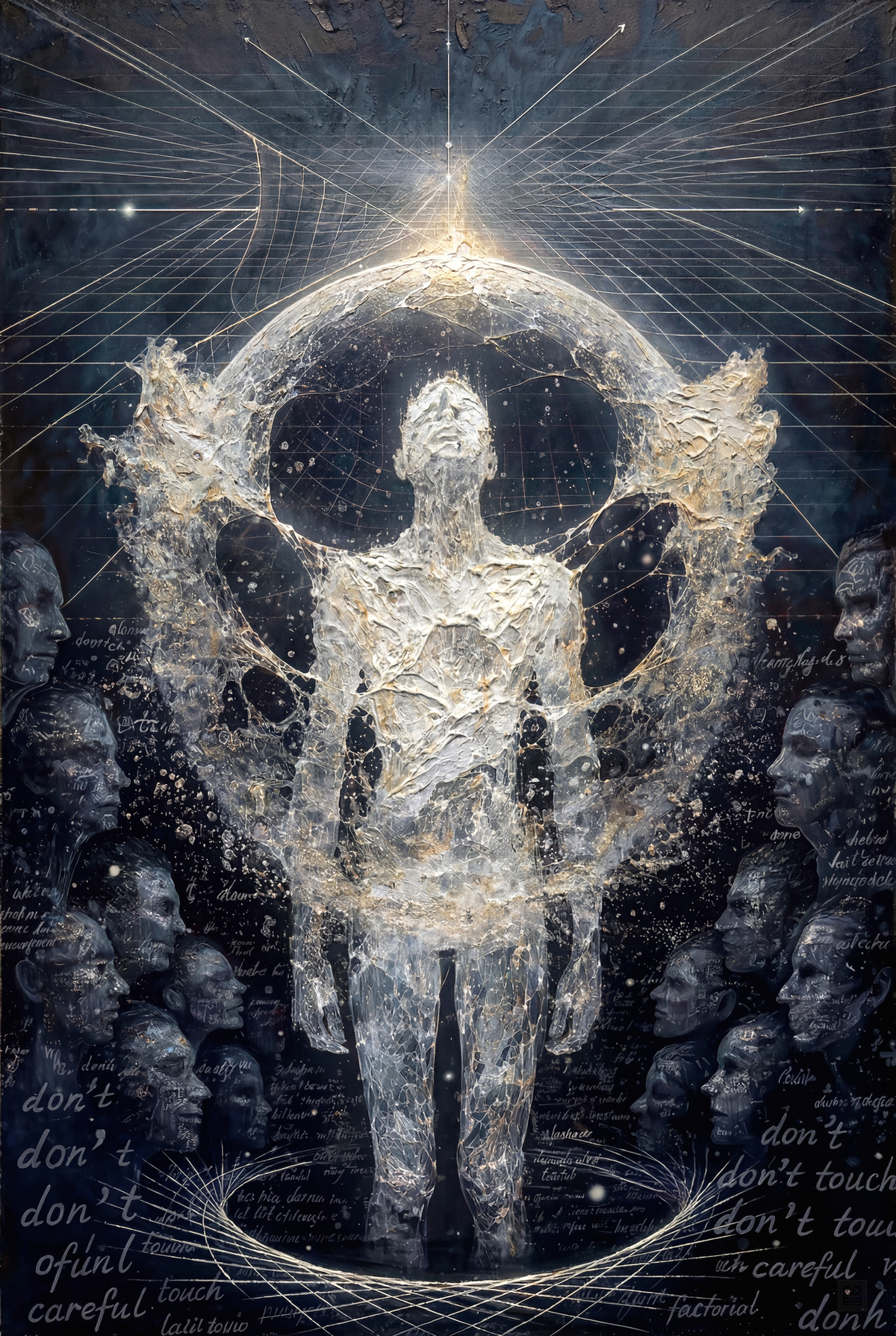
Именно поэтому страх так легко кажется естественным: он передаётся не только через травму, но и через норму — через воспитание, предупреждение, пример, через бесконечное «нельзя», «осторожно», «не трогай». Усвоенная таким образом теснота становится не просто фоном, а первой формой того, что человек назовёт собой.
Повседневная «забота» — пожалуй, самый незаметный, но при этом самый радикальный инструмент онтологического разделения. Оберегая ребёнка от воображаемого или преувеличенного вреда, взрослые транслируют ему не просто правила безопасности, а скрытую метафизическую аксиому: мир вокруг фундаментально опасен и чужероден, а ты, находящийся здесь — хрупок, мал и отделён от него. В каждом бытовом «оденься теплее», «не беги — упадёшь», «дай я сделаю сам, ты испортишь» заложена не только любовь, но и жест отсечения. Ребёнку навязывают идентичность того, кто постоянно нуждается в защите от внешней среды. Так забота строит тюрьму эго, искусно маскируя её под уютное и безопасное убежище. В результате человек привыкает покупать безопасность ценой тотальной изоляции, а самосохранение становится главным, если не единственным мотивом его присутствия в мире.
Эта граница пролегает не только в мышлении. Когда психика усваивает разделённость, нервная система переводит её на язык физиологии — в хроническое напряжение, сжатое дыхание, зажатую челюсть, собранные плечи, постоянную готовность к защите. Тело становится соматическим способом удерживать себя как отдельное существо. Граница начинает существовать не только как идея, но и как устойчивый паттерн переживания, вписанный в мышечный тонус, дыхание и повседневные реакции.
Язык закрепляет ту же структуру. Большинство языков организует опыт через отношения субъекта и объекта. Когда говорится: «я испытываю страх», уже предполагается существование отдельного носителя переживания и самого переживания как чего-то, происходящего с ним. Язык не создаёт разделённость сам по себе, но постоянно предлагает форму, в которой она становится очевидной, привычной и само собой разумеющейся. Таким образом он не просто описывает переживание, а участвует в воспроизводстве способа видеть мир.
Страх связан не только с разделением пространства на «я» и «не-я», но и времени на настоящее и возможное будущее. Опасность ещё не наступила, но уже переживается как реальная. Сознание уводится в область предположений, прогнозов и сценариев. Поэтому страх оказывается способом жить не в происходящем, а в проекции того, что может произойти. В этом смысле он удерживает не только структуру личности, но и саму психологическую структуру времени.
Из этой конструкции рождается особый способ существования: ориентация на утрату как исходная структура восприятия. Мир переживается как пространство, в котором всё данное уже заранее помечено возможным отсутствием. Желание в этой оптике неотделимо от тревоги потери, близость — от ожидания отвержения, забота о себе — от хронического самосохранения.
Даже страх смерти обнаруживает здесь свою особую природу. Он связан не только с прекращением жизни как биологического процесса, но и с возможностью распада той формы идентичности, с которой человек себя отождествил. Угроза смерти переживается как угроза исчезновения самой границы, через которую «я» привыкло узнавать себя. Поэтому страх смерти оказывается предельным выражением более общего страха — страха утраты отдельности.
Из этого следует и возможность иной работы со страхом — не как борьбы с симптомом, а как исследования его источника. Когда внимание обращается не на объект страха, а на саму структуру того, кто боится, обнаруживается, что страх и образ отдельного «я» возникают вместе и взаимно поддерживают друг друга. Тогда вопрос перестаёт звучать как «как избавиться от страха?» и начинает звучать иначе: «что именно требует защиты?».
Это не означает мгновенного исчезновения страха. Но страх перестаёт восприниматься как внешний враг или самоочевидная реальность. Он становится указанием на место, где сознание переживает себя отдельным. И чем яснее виден этот механизм, тем меньше страх способен выполнять свою главную функцию — быть тем, через что «я» подтверждает собственное существование. В этой точке страх перестаёт быть исключительно проблемой и становится возможностью исследовать саму природу разделённости.
Fear as a Form of Separateness
On the Origin of Fear in the Structure of the Ego and Internalized Duality
Where the “I” arises, vulnerability arises with it. But the reverse is equally true: as long as fear persists, so does the “I.”
Fear cannot be reduced to biological instinct, because it arises not only from direct threat, but from the very structure of the ego — from the division between “I” and “not-I.” Instinct responds to immediate danger and, as a rule, subsides once the danger has passed. Fear, by contrast, begins where a separate “I” emerges, compelled to defend itself against everything experienced as external, alien, and capable of wounding, rejecting, or destroying it. Unlike an instinctive reaction, fear can persist without any immediate object: it anticipates events, generates imagined scenarios, and lives in expectation of what has not yet happened.
What matters here is not only the causal relation, but also its reversal: fear does not merely arise from separateness — it sustains it. The boundary between the “I” and the world seems real precisely because it is experienced as painful. Each act of fear returns attention to the one who must be protected. Fear therefore does not simply serve the separate “I” — it continually reproduces it as the center of experience. It becomes the means by which divided consciousness confirms its own separateness.
The ego does not arise in a vacuum. It is formed through language, memory, prohibitions, judgments, shame, the anxieties of adults, and collectively inherited ways of seeing the world. The child inherits this outlook before acquiring the capacity to question it. Fear, therefore, is not simply absorbed from outside — it participates in the very construction of the “I,” becoming one of its original materials.
This is precisely why fear so easily appears natural: it is transmitted not only through trauma, but through norm — through upbringing, warnings, example, through the endless “don’t,” “be careful,” “don’t touch.” The constriction internalized in this way becomes not merely a background, but the first form of what a person will come to call the self.
Everyday “care” is perhaps the least noticeable and yet the most radical instrument of ontological division. By protecting the child from imagined or exaggerated harm, adults transmit not merely rules of safety, but a hidden metaphysical axiom: the world around you is fundamentally dangerous and alien, while you, within it, are fragile, small, and separate from it. In every ordinary “put on something warmer,” “don’t run — you’ll fall,” or “let me do it, you’ll ruin it,” there lies not only love, but also an act of severance. The child is assigned the identity of one who constantly requires protection from the external environment. In this way, care constructs the prison of the ego, skillfully disguising it as a warm and secure refuge. As a result, a person becomes accustomed to purchasing safety at the cost of total isolation, and self-preservation becomes the primary, if not the only, motive of their presence in the world.
This boundary runs not only through thought. When the psyche internalizes separateness, the nervous system translates it into the language of physiology — into chronic tension, constricted breathing, a clenched jaw, tightened shoulders, and a constant readiness for defense. The body becomes a somatic means of maintaining oneself as a separate being. The boundary comes to exist not only as an idea, but as a stable pattern of experience, inscribed in muscular tone, breath, and everyday reactions.
Language reinforces the same structure. Most languages organize experience through the relation between subject and object. When one says, “I feel fear,” the existence of a separate bearer of experience is already presupposed, along with the experience itself as something that happens to that bearer. Language does not create separateness on its own, but it continually offers the form in which separateness becomes obvious, habitual, and self-evident. In this way, it does not merely describe experience, but participates in reproducing a way of seeing the world.
Fear is tied not only to the division of space into “I” and “not-I,” but also to the division of time into the present and a possible future. The danger has not yet arrived, and yet it is already experienced as real. Consciousness is drawn into the realm of suppositions, projections, and scenarios. Fear thus becomes a way of living not in what is happening, but in a projection of what may happen. In this sense, it sustains not only the structure of the person, but the very psychological structure of time.
From this construction emerges a particular mode of existence: an orientation toward loss as the foundational structure of perception. The world is experienced as a space in which everything given is already marked in advance by the possibility of absence. Within this outlook, desire is inseparable from anxiety over loss, intimacy from the anticipation of rejection, and self-care from chronic self-preservation.
Even the fear of death reveals its particular nature here. It is connected not only to the cessation of life as a biological process, but also to the possible dissolution of the form of identity with which a person has identified. The threat of death is experienced as the threat of the disappearance of the very boundary through which the “I” has learned to recognize itself. The fear of death thus becomes the most extreme expression of a more general fear — the fear of losing separateness.
From this follows the possibility of a different way of engaging with fear — not as a struggle against a symptom, but as an investigation of its source. When attention turns not toward the object of fear, but toward the very structure of the one who fears, it becomes clear that fear and the image of a separate “I” arise together and sustain one another. The question then ceases to be “How do I get rid of fear?” and begins to sound otherwise: “What exactly is it that requires protection?”
This does not mean that fear disappears at once. But fear ceases to be perceived as an external enemy or a self-evident reality. It becomes an indication of the place where consciousness experiences itself as separate. And the more clearly this mechanism is seen, the less capable fear becomes of performing its central function: serving as that through which the “I” confirms its own existence. At this point, fear ceases to be merely a problem and becomes an opportunity to investigate the very nature of separateness.
Fear is not biological instinct; it arises from the ego’s division of reality into "I" and "not-I." Instinct reacts and subsides, but fear anticipates, continuously reproducing the separate self it seeks to protect. The ego is constructed through language, norms, and everyday care, which masterfully disguises isolation as a refuge, framing the world as hostile and the self as fragile. This boundary is reinforced somatically through chronic tension and constricted breathing, and linguistically via subject-object grammar. By distorting time into projected futures, fear shapes desire and intimacy with anxiety, organizing life around anticipated loss and the fear of death as identity dissolution. Ultimately, fear and the separate "I" co-create one another. When attention shifts from the object of fear to the subject, asking what requires protection, fear loses its primary function and can no longer validate the ego's existence.