The human flea: science's NPC and the anti-method

THE HUMAN FLEA: SCIENCE'S NPC AND THE ANTI-METHOD
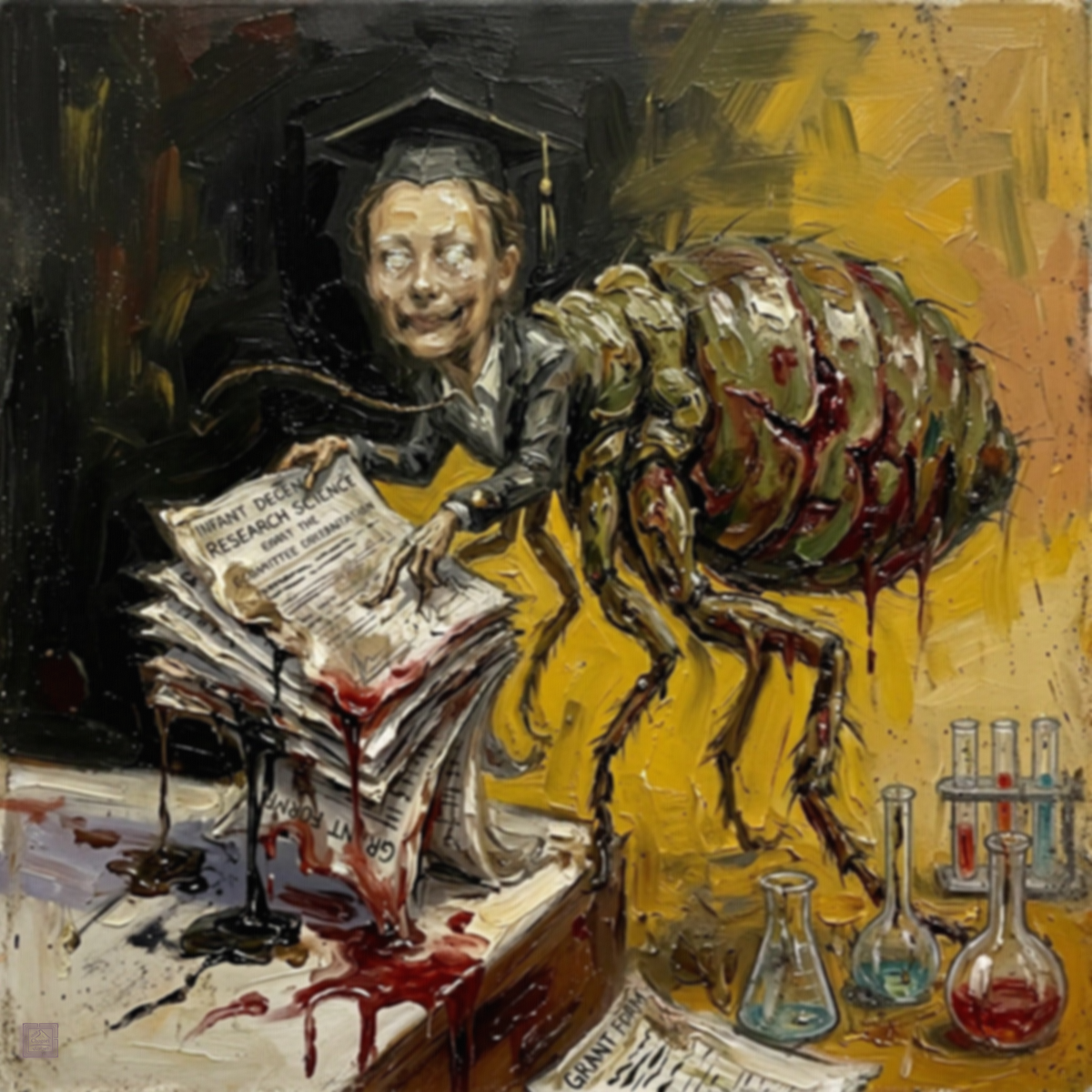
There is a particular subspecies of the academic fauna — the human flea. It does not think, does not investigate, does not create. It parasitizes.
The human flea lives wherever the illusion of intellectual prestige still holds: in science, education, analytics. Not because it can contribute anything, but because these are convenient places to hide one's worthlessness behind other people's texts, other people's language, and other people's authority.
It knows nothing and has no position of its own, yet speaks politely and with confidence. It understands nothing, yet rushes to comment, citing inflated "authorities." It cannot do anything of substance, but loves to be around those who can. It gets grotesque: the flea hangs on every word of its own PhD students, hunting for a thought — any thought, any position — that it can later pin to its chest as "expertise."
It does not need a result. It needs a ritual it can pass off as a result. Not knowledge — but a report, a grant, a line on the CV, an impression made on a committee or a manager. Any living movement of thought that doesn't fit into a form it perceives as a threat — not because the thought is wrong, but because it cannot be converted into its currency: reports, statuses, managed noise.
1. Not weakness, and not "just mediocrity"
The human flea is not "stupid" and not simply a weak specialist. This is not about IQ or typing speed. It is about orientation toward truth and the refusal to carry epistemic responsibility.
A mediocre but honest researcher can be wrong, move slowly, write clumsily — but they acknowledge mistakes, change their position under pressure of data, learn from failure. The human flea is fundamentally indifferent to whether what it produces is true: its horizon is the report and the impression, not reality.
Mediocrity is limited by ability but compatible with science: such a person can perform routine measurements, maintain infrastructure, carefully move bricks from task to task. The flea is by definition incompatible with science: its survival strategy is to blur quality criteria, replace method with ritual, and declare the very idea of verification and falsifiability testing "toxic," "unconstructive," "uncollegial."
Strip away status, committees, and bureaucracy, and the mediocre scientist is still useful to science and capable of a local contribution. The human flea simply disappears: its only resource is other people's work and other people's status, to which it attaches itself in the form of collaborations. This is not a "loser" but an active carrier of anti-method: not someone who cannot, but someone who does not want method to work at all.
The distinction matters: honest mediocrity is limited power, but a preserved connection to reality; the human flea is a deliberate severance from reality in order to preserve status. In the first case, weakness does not affect the overall pace of progress, because the desire to learn and the drive toward knowledge are still intact. In the second, the parasite blocks the very possibility of progress, because any strengthening of method automatically devalues its existence.
2. The ecology of fleas: meaningless bustle as respiration
Their natural habitat is meaningless collective bustle. Meetings. Calls. Workshops. "Strategic sessions." "Goal alignment."
Rituals after which no one became any smarter and nothing moved forward by a millimeter. If there is nothing to produce — produce noise. If there is nothing to say — call a meeting. If there is no competence — crank up enthusiasm and "teamwork" until they drown out the actual work. If there is stupidity inside — outside there must be performed solemnity, PowerPoint, and corporate newspeak-manure.
The human flea exists as a constant itch around thought. It is incapable of sustained work: it jumps from topic to topic, finishes nothing, rushes and pesters those who actually work — and in doing so creates the appearance of an "active environment" where something is supposedly happening.
This kind of bustle has its own simple physics. Any real work requires silence, focus, and prolonged contact with the problem. Any flea-meeting ecosystem destroys silence, chops time into slots, and packs the calendar with an endless series of "important calls" where genuine thinking is impossible. The result is an environment that is formally "dynamic" but in practice turns into thick sludge: everyone is always rushing somewhere and meeting about something — and for exactly that reason nothing ever has time to mature.
3. The topology of harm: capturing the environment
The flea does not merely irritate. It restructures the environment so that simulation is more rewarding than work, and noise is safer than thought.
First, it redistributes attention — the primary scarce resource of science. A living researcher wants to be in the lab, with the data, with the problem. The flea drags them toward "strategy," "roadmaps," "stakeholder communication," where one can talk indefinitely and be accountable for nothing. Time stolen, experiment unrun, thought unborn.
Second, fleas train the young. Newcomers enter science for contact with reality and instead land in a school of simulation. They are taught not method but the ritual of success: how to write grants, how to please panels, how to run "projects" that cannot fail. PhD factories stamp out not researchers but minor bureaucrats of knowledge, for whom "research" is simply the language used to package career moves.
Third, fleas dissolve the criteria of truth. Where they dominate, quality stops being measured by accuracy, reproducibility, and predictive power, and starts being measured by journal prestige, ideological "correctness," and the absence of "reputational risk." The risky, the uncomfortable, the counterintuitive get squeezed out; safe imitation of research remains.
Fourth, they seize the distribution points. Fleas cluster wherever grants, positions, prizes, and statuses are handed out. Unable to assess quality, they rely on noise, loyalty, and ritual fluency — the ability to speak the bureaucratic dialect of "excellence" and "impact." Money and attention flow not toward where a breakthrough is possible, but toward where the theater of busyness is most convincing.
Finally, they poison language. Where one could say "this doesn't work" or "we don't know," there appears instead "a complex multi-stakeholder reality," "an area for growth," and "a direction for further work." Speech stops describing the world and becomes a magical ritual for maintaining status. In this topology, the honest and direct person becomes locally maladaptive: the clearer and more precise they are, the more problems they create for themselves inside a system that survives by not-seeing.
Language is the primary vector of infection. Adopt a few of these formulas into your own vocabulary, and the flea has already half moved in: where once there was a plain "no" or "this is nonsense," there now appears the smooth "there are questions around the methodology" and "the results are not entirely convincing" — which change nothing but preserve the face of the ritual.
4. The anatomy of the NPC: BIOS wiped, scripts remain
The human flea is not simply a weak specialist or someone who got unlucky. It is a type in which thinking has been displaced by a set of career habits and defensive reflexes.
It does not ask itself whether something is true or whether it works. It asks how to present it, who to show it to, and how to get through the next procedure without personal damage. So when asked for a result, it responds not with a result but with a sufficiently presentable imitation — good enough to file a report, save face, and move on.
Their intelligence is not the ability to solve a problem but the speed at which they find the right button in the grant application interface. They were trained by PhD factories where instead of philosophy, method, and scientific ethics, they were drilled in ritual: how to write a proposal tailored to a funding template, how to simulate "scientific novelty" in four boilerplate paragraphs, how to smile correctly on a Zoom call with the microphone off.
The core competency here is ritual fluency. A living researcher slows down because they are thinking. The flea does not think — it executes the subroutine "Q2Report_v3finalFINALrevised."
It almost always exhibits the same cluster of traits: irresponsibility normalized into a lifestyle; narcissism stretched over an inferiority complex; absence of basic knowledge combined with iron certainty in one's own "expertise"; inability to think in terms of cause and effect; total ignorance of the scientific method — and zero desire to fix that.
Science demands discipline, doubt, foundational knowledge, hypothesis testing, acknowledgment of error — that is, responsibility and integrity. The flea operates on the opposite principles: self-satisfaction instead of doubt, posturing instead of knowledge, chatter instead of analysis, herd ritual instead of verification.
It does not research — it accompanies research with parasitic noise. It does not think — it occupies space around thought. It does not create knowledge — it obstructs those who still can.
Any attempt at a meta-conversation — "what are we actually doing and why?" — is immediately flagged as "toxicity," "negativity," "undermining team spirit." This NPC-BIOS protects itself from being overwritten: anything that might awaken doubt is declared a violation of corporate ethics.
5. Publications and language as camouflage
Scientific truth does not matter to the flea — a line on the CV does. It publishes indiscriminately, fully aware of the flimsiness of its own "results." It will not retract a paper even when colleagues demonstrate a clear error to its face: that damages the career and the image. It does not need honesty. It needs the approval of other fleas and the blessing of whatever committee currently controls the resource stream.
What makes it particularly repugnant is the human flea's habit of hiding behind words: science, development, team, values, dialogue, community, inclusion.
Beneath this verbal mold lies something simple: they are useless but want to be indispensable; they can do nothing but want influence; they understand nothing but want to control the allocation of attention, resources, and status.
The less understanding — the more performative energy. The less knowledge — the stronger the craving for endless discussion. The less real contribution — the louder the talk about the importance of one's "role" and "mission." The greater the internal worthlessness — the stronger the dependence on collective bustle as a life-support system.
A report, a paper, a public talk — these are not, for the flea, forms of capturing knowledge. They are layers of camouflage. Each page of text is one more millimeter of asphalt poured over a hole in reality. Inside there is incompetence or outright falsity, but as long as the document looks "as it should," the system concludes that work has been done.
6. NPCs of the academic world, and the outcome
This is the NPC of the scientific environment: hypocritical, with a polite dutiful smile, irresponsible, self-absorbed, ignorant, actively useless. They produce nothing but exhaustion, noise, and drag.
Like the meme NPC, the human flea runs on scripted lines supplied by bureaucracy and media, with no inner monologue and no capacity for critical thought. It scripts: "area for growth," "interdisciplinary synergies," "sustainable development" — rather than acknowledging the simple "we don't know" or "this doesn't work."
The more of them there are — and their numbers grow with every new wave of PhD factories and the expansion of managerial structures in science — the faster any living intellectual environment turns into a swamp. Instead of thought, communication. Instead of knowledge, intonation. Instead of work, an eternal meeting about nothing.
A parasite that finally kills its host dies with it. A scientific environment wholly captured by fleas survives for a while on the inertia of old achievements, grant shamanism, and brand capital — but inside it is already dead: there is nothing left to grow, nothing left to fail, nothing left to discover.
7. What to do about it
The human flea cannot be cured by argument or educated by discussion. It has no deficit of information — it has no interest in reality.
The only remedy is refusal to participate in its rituals: don't attend meetings for the sake of meetings; don't play along with artificial "teamwork"; don't mistake noise for activity; don't allow fleas to define reality for those who are still capable of thinking.
Minimal bureaucracy is infrastructure. The flea-system is a cult. The first helps run cables, order reagents, and file travel expenses. The second exists for its own sake, multiplying reports about work that was never done.
Any environment that does not resist fleas is doomed to become a sterile, talkative, safe little cage — where thought has already died but still carries on talking to itself out of habit. The only way to avoid becoming its contents is to build parallel spaces: small, informal, free of grant liturgy, where it is still possible to call nonsense nonsense, and reality reality.
ЧЕЛОВЕК-БЛОХА: NPC НАУКИ И АНТИ‑МЕТОД
Есть особый подвид околонаучной фауны — человек‑блоха. Он не мыслит, не исследует, не создаёт. Он паразитирует.
Человек‑блоха живёт там, где ещё держится иллюзия престижа ума: в науке, образовании, аналитике. Не потому, что способен внести вклад, а потому что там удобно прятать собственную никчёмность за чужими текстами, чужим языком и чужим авторитетом.
Он ничего не знает и не имеет собственной позиции, но говорит вежливо и уверенно. Ничего не понимает, но лезет комментировать, ссылаясь на надутых «авторитетов». Ничего не может сделать по существу, но обожает быть рядом с теми, кто может. Доходит до гротеска: он заглядывает в рот собственным аспирантам — в поисках мысли, хоть какой‑то позиции, которую потом можно повесить себе на грудь как «экспертность».
Ему не нужен результат. Ему нужен ритуал, который можно выдать за результат. Не знание — а отчёт, грант, строчка в CV, впечатление на комитет или начальство. Любое живое движение мысли, которое не укладывается в формуляр, он воспринимает как угрозу — не потому, что оно ошибочно, а потому, что оно не переводится в его валюту: отчёты, статусы, управляемый шум.
1. Не слабость и не «просто посредственность»
Человек‑блоха — не «глупый» и не просто слабый специалист. Это не про IQ и не про скорость набора текста. Это про ориентацию к истине и отказ от эпистемической ответственности.
Посредственный, но честный исследователь может ошибаться, двигаться медленно, писать коряво — но он признаёт ошибки, меняет позицию под давлением данных, учится на провалах. Человеку‑блохе принципиально плевать, истинно ли то, что он производит: его горизонт — отчёт и впечатление, а не реальность.
Посредственность ограничена способностями, но совместима с наукой: такой человек может делать рутинные измерения, поддерживать инфраструктуру, аккуратно таскать кирпичи от задачи к задаче. Блоха по определению с наукой несовместима: её способ выживания — размывать критерии качества, подменять метод ритуалом, объявлять саму идею проверки и поиска фальсификации «токсичной», «неконструктивной», «неколлегиальной».
Если вычесть статус, комитеты и бюрократию, посредственный учёный всё равно полезен науке и способен на локальный вклад. Человек‑блоха просто исчезает: его единственный ресурс — чужой труд и чужой статус, к которым он присасывается в виде коллабораций. Это не «лузер», а активный носитель антиметода: не тот, кто не может, а тот, кто не хочет, чтобы метод вообще работал.
Важно не путать: честная посредственность — это ограниченная мощность, но сохранённая связь с реальностью; человек‑блоха — это сознательный разрыв с реальностью ради сохранения статуса. В первом случае слабость не влияет на скорость прогресса в целом, так как есть желание учиться и стремление к знанию. Во втором паразит блокирует саму возможность прогресса, потому что любое усиление метода автоматически обесценивает его существование.
2. Экология блох: бессмысленная суета как дыхание
Их естественная среда — бессмысленная коллективная суета. Встречи. Созвоны. Обсуждения. «Стратегические сессии». «Выравнивание по целям».
Это ритуалы, после которых никто не стал умнее, а дело не сдвинулось ни на миллиметр. Если нечего производить — производят шум. Если нечего сказать — созывают обсуждение. Если нет компетентности — включают бурный энтузиазм и «командность», забивающие саму работу. Если внутри тупость — снаружи должна быть напускная солидность, PowerPoint и корпоративный новояз-навоз.
Человек‑блоха существует как постоянный зуд вокруг мысли. Он не способен на работу: скачет с темы на тему, ничего не доводит до конца, торопит и дёргает тех, кто реально работает, — и этим создаёт видимость «активной среды», где как будто что‑то происходит.
У такой суеты есть своя простая физика. Любое реальное дело требует тишины, фокуса и продолжительного контакта с задачей. Любая блохосовещательная экосистема уничтожает тишину, дробит время на слоты, впечатывает в календарь бесконечный ряд «важных созвонов», где нельзя ни о чём думать по‑настоящему. В результате среда, формально «динамичная», по факту превращается в вязкую жижу: все всё время куда‑то бегут и совещаются — и ровно поэтому ничто не успевает дозреть.
3. Топология вреда: перехват среды
Блоха не просто раздражает. Она перестраивает среду так, чтобы симуляция была выгоднее работы, а шум — безопаснее мысли.
Во‑первых, она перераспределяет внимание — главный дефицит науки. Живой исследователь хочет в лабораторию, к данным, к задаче. Блоха тащит его на «стратегию», «дорожную карту», «коммуникацию со стейкхолдерами», где можно бесконечно говорить и ни за что не отвечать. Время украдено, эксперимент не поставлен, мысль не родилась.
Во‑вторых, они дрессируют младших. Новички приходят в науку ради контакта с реальностью, а попадают в школу симуляции. Их учат не методу, а ритуалу успеха: как писать гранты, как нравиться панели, как запускать «проекты», которые не могут провалиться. PhD‑фабрики штампуют не исследователей, а мелких бюрократов от науки, для которых «исследование» — это язык упаковки карьерных ходов.
В‑третьих, блохи размывают критерии истины. Там, где они доминируют, качество перестаёт измеряться точностью, воспроизводимостью и предсказательной силой, а начинает измеряться престижем журнала, идеологической «правильностью» и отсутствием «репутационных рисков». Рисковое, неудобное, контринтуитивное выдавливается; остаётся безопасная имитация исследования.
В‑четвёртых, они захватывают точки распределения. Блохи лезут туда, где раздаются гранты, ставки, премии, статусы. Не умея различать качество, они полагаются на шум, лояльность и ритуальную беглость — на умение говорить на бюрократическом диалекте «экселленса» и «импакта». Деньги и внимание текут не туда, где возможен прорыв, а туда, где сильнее всего театр занятости.
Наконец, они отравляют язык. Там, где можно сказать «это не работает» или «мы не знаем», появляется «сложная многокомпонентная реальность», «зона роста» и «направление для дальнейшей работы». Речь перестаёт описывать мир и превращается в магический ритуал поддержания статуса. В такой топологии честный и прямой человек становится локально дефективным типом: чем он яснее и точнее, тем больше проблем создаёт себе в системе, которая выживает за счёт не‑видения.
Именно язык — главный переносчик заразы. Стоит принять пару этих формул в собственный словарь, и блоха уже наполовину поселилась внутри: там, где раньше был простой «нет» или «хрень», появляется обтекаемое «есть вопросы к методологии» и «не до конца убедительные результаты», которые не меняют ничего, но сохраняют лицо ритуала.
4. Анатомия NPC: BIOS стёрт, остались скрипты
Человек‑блоха — не просто слабый специалист и не человек, которому не повезло. Это тип, у которого мышление вытеснено набором карьерных привычек и защитных рефлексов.
Он не спрашивает себя, правда ли это и работает ли это вообще. Он спрашивает, как это подать, кому показать и как пройти через очередную процедуру без ущерба для себя. Поэтому на любой запрос о результате он отвечает не результатом, а его имитацией — достаточно приличной, чтобы отчитаться, сохранить лицо и двинуться дальше.
Их интеллект — это не способность решить задачу, а скорость нахождения нужной кнопки в интерфейсе грантовой заявки. Их обучили PhD‑фабрики, где вместо философии, метода и научной этики вдалбливали ритуал: как написать заявку под гребёнку фонда, как имитировать «научную новизну» четырьмя шаблонными абзацами, как правильно улыбаться на Zoom‑совещании с выключенным микрофоном.
Ключевая компетенция здесь — ритуальная беглость. Живой исследователь останавливается, делает паузу, потому что думает. Блоха не думает — она исполняет подпрограмму «Отчётквартал_2финалфиналправки».
У неё почти всегда один и тот же набор признаков: безответственность, превращённая в норму; нарциссизм, натянутый поверх комплекса неполноценности; отсутствие базовых знаний при железной уверенности в собственной «экспертности»; неспособность мыслить причинно‑следственно; полное непонимание научного метода — и нулевая потребность его понимать.
Наука требует дисциплины, сомнения, знания основ, проверки гипотез, признания ошибок — то есть ответственности и совести. Блоха живёт наоборот: самодовольство вместо сомнения, поза вместо знания, болтовня вместо анализа, стадный ритуал вместо проверки.
Она не исследует — сопровождает исследование паразитическим шумом. Не думает — занимает место вокруг мысли. Не создаёт знание — мешает тем, кто ещё способен.
Любая попытка мета‑разговора — «что мы вообще делаем и зачем?» — тут же маркируется как «токсичность», «негатив», «подрыв командного духа». Этот NPC‑биос защищает себя от перезаписи: всё, что может разбудить сомнение, объявляется нарушением корпоративной этики.
5. Публикации и речь как маскировка
Научная истина блохе не нужна — ей нужна строка в резюме. Она публикует всё подряд, отлично понимая хлипкость собственных «результатов». Она не отзовёт статью, даже если ей в лицо показали явную ошибку: это бьёт по карьере и образу. Ей не нужна честность. Ей нужно одобрение таких же блох и благословение комитета, контролирующего поток ресурсов.
Особенно мерзко то, как человек‑блоха прячется за словами: наука, развитие, команда, ценности, диалог, комьюнити, инклюзия.
Под этой словесной плесенью всё просто: они бесполезны, но хотят быть незаменимыми; ничего не умеют, но хотят влиять; ничего не понимают, но хотят распределять внимание, ресурсы и статус.
Чем меньше понимания — тем больше показной энергии. Чем меньше знания — тем сильнее тяга к бесконечным обсуждениям. Чем меньше реального вклада — тем громче разговоры о важности «своей роли» и «миссии». Чем больше внутренняя никчёмность — тем сильнее зависимость от коллективной суеты как аппарата жизнеобеспечения.
Отчёт, статья, публичное выступление для неё — это не формы фиксации знания, а слои маскировки. Страница текста — ещё один миллиметр асфальта, которым заливается дыра в реальности. Внутри несостоятельность или прямая фальшь, но пока документ выглядит «как надо», система считает, что работа проделана.
6. NPC научной среды и исход
Это и есть NPC научной среды: лицемерные, с вежливой дежурной улыбкой, безответственные, самовлюблённые, невежественные, деятельно‑бесполезные. Они не производят ничего, кроме утомления, шума и торможения.
Как и мемный NPC, человек‑блоха живёт на готовых репликах бюрократии и медиа, без внутреннего диалога и критического мышления. Он скриптует: «зона роста», «междисциплинарные синергии», «устойчивое развитие» — вместо того чтобы признать простое «мы не знаем» или «это не работает».
Чем больше их становится — а их становится больше с каждой новой волной PhD‑штамповки и разрастанием управленческих структур, — тем быстрее любая живая интеллектуальная среда превращается в болото. Вместо мысли — коммуникация. Вместо знания — интонация. Вместо работы — вечное совещание ни о чём.
Паразит, который окончательно убивает хозяина, умирает вместе с ним. Научная среда, целиком захваченная блохами, ещё какое‑то время живёт на инерции старых достижений, грантового шаманства и бренд‑капитала, но внутри уже мертва: там больше нечему расти, нечему проваливаться и нечему открываться.
7. Что с этим делать
Человек‑блоха не лечится аргументами и не воспитывается дискуссиями. У него нет дефицита информации — у него отсутствует интерес к реальности.
Единственное лекарство — отказ от участия в его ритуалах: не ходить на встречи ради встреч; не подыгрывать искусственной «командности»; не признавать шум за деятельность; не позволять блохам описывать реальность тем, кто ещё способен думать.
Минимальная бюрократия — это инфраструктура. Блохосистема — это культ. Первая помогает тянуть провода, закупать реактивы и оформлять командировки. Вторая живёт ради себя самой, умножая отчёты о проделанной работе, которой не было.
Любая среда, которая не сопротивляется блохам, обречена стать стерильной, говорливой, безопасной клеткой — где мысль уже умерла, но по инерции всё ещё разговаривает сама с собой. Единственный способ не превратиться в её содержимое — строить параллельные пространства: маленькие, неформальные, без грантовых богослужений, где ещё можно назвать хрень хренью, а реальность — реальностью.
THE HUMAN FLEA: SCIENCE'S NPC
There is a particular subspecies of academic fauna — the human flea. It does not think, does not investigate, does not create. It parasitizes.
It lives wherever the illusion of intellectual prestige holds: in science, education, analytics. Not to contribute — but to hide its worthlessness behind other people's texts, language, and authority.
It knows nothing but speaks with confidence. Understands nothing but rushes to comment. Can do nothing but loves being near those who can.
It does not need results. It needs rituals it can pass off as results.
Its habitat is meaningless collective bustle — meetings, calls, "strategic sessions" — rituals after which no one became smarter and nothing moved forward.
The flea does not merely irritate. It restructures the environment so that simulation is more rewarding than work, and noise safer than thought.
It cannot be cured by argument. The only remedy is refusal to participate in its rituals.
Any environment that doesn't resist fleas becomes a sterile, talkative cage — where thought has died but still talks to itself.