Where Is Forward Here

Где здесь вперед
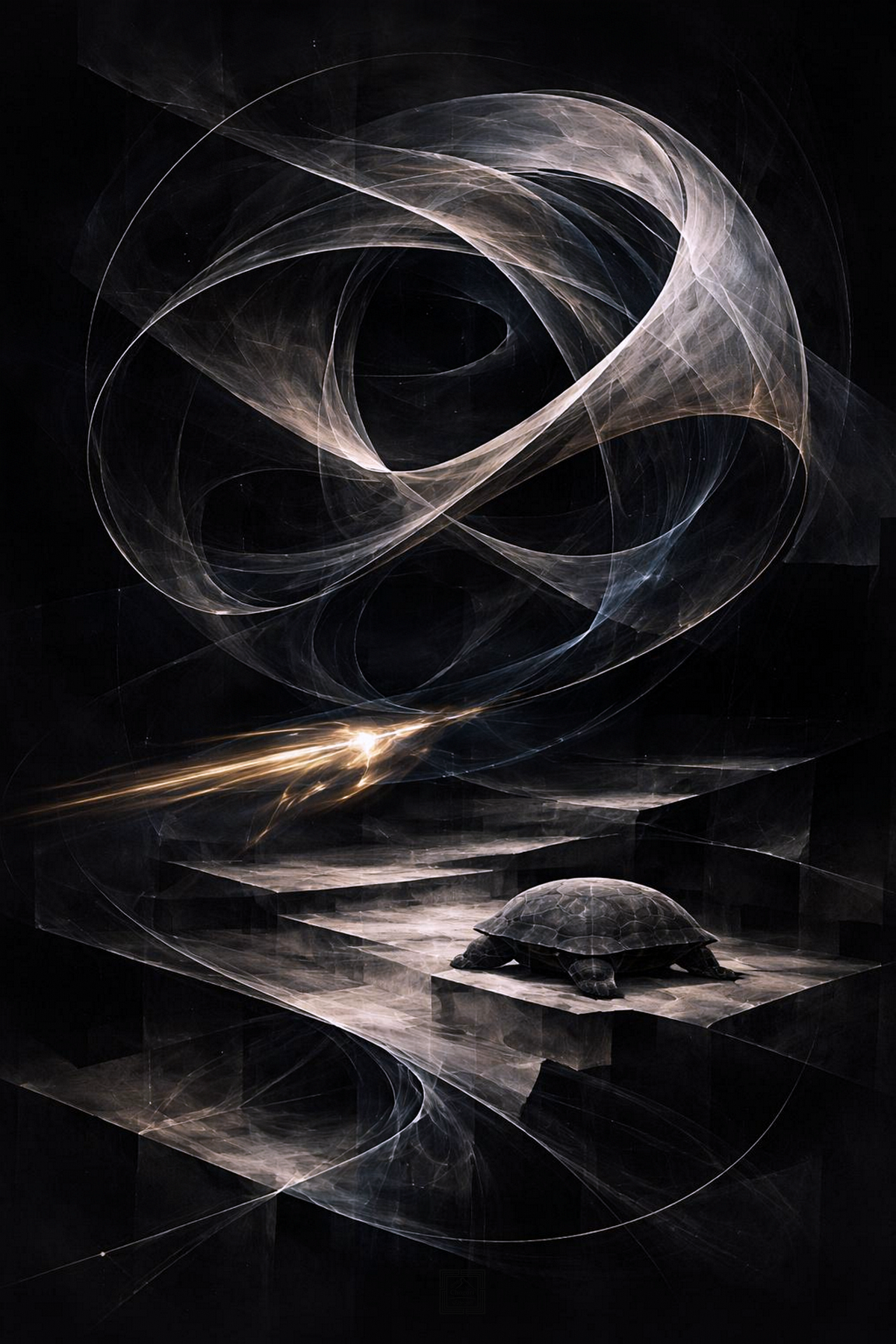
Зенон не задал для своей апории единственной геометрии. Он не потребовал, чтобы Ахилл и черепаха бежали по евклидовой прямой, в ровном пространстве и при общем понимании дистанции. Поэтому апория действует и там, где сама поверхность пути свернута, сложена в складки и одностороння. В таком пространстве недостижимость перестаёт быть только логической фигурой и становится свойством сцены.
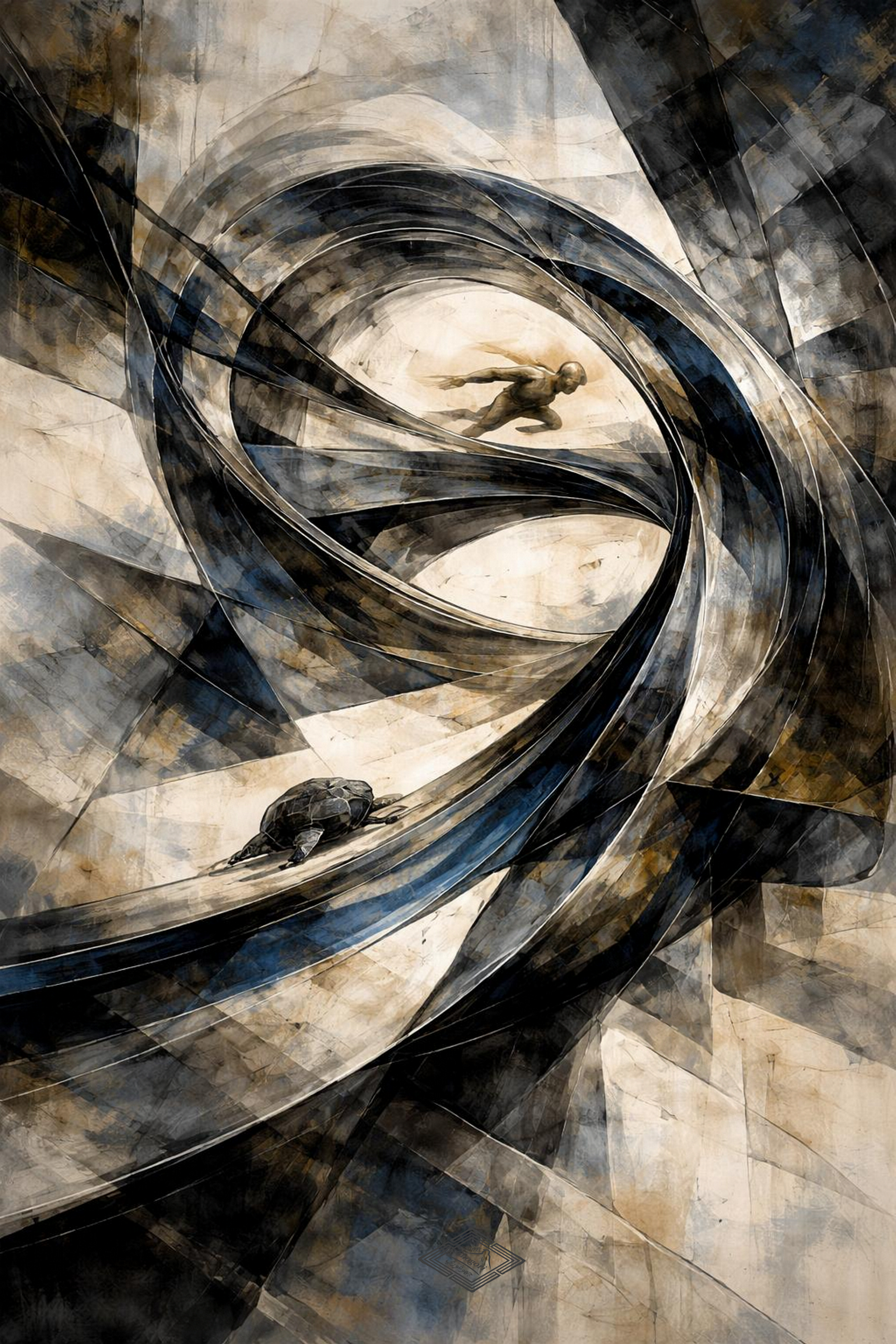
Монах спросил: если Ахилл движется по линии на многократно свернутой поверхности Мёбиуса, а черепаха идёт по её рёбрам, кто из них впереди?
Мастер ответил: сперва узнай, где здесь впереди.
Монах сказал: черепаха всё равно приходит раньше.
Мастер ответил: не раньше — иначе.
Речь не о том, что медленное существо вдруг побеждает быстрое. Речь о том, что скорость перестаёт решать, когда пространство больше не удерживает привычных связей между стороной, направлением, близостью и длиной пути. Если поверхность не даёт устойчивого «вперёд», то и догнать уже нельзя свести к скорости. Тогда вопрос не в том, насколько быстр Ахилл, а в том, что вообще считать одним и тем же путём.
Эта работа не пересказывает Зенона и не украшает его метафорой. Она продолжает его жест в другой геометрии. Апория переносится туда, где движение расслаивается, а достижение становится сомнительным не потому, что телу чего-то не хватает, а потому, что пространство больше не обязано подчиняться прямой.
Черепаха опережает Ахиллеса не потому, что она быстрее.
Ахилл проигрывает прямой, которую слишком рано назвал прямой.
Where Is Forward Here
Zeno never assigned his paradox a single geometry. He did not require Achilles and the tortoise to run along a Euclidean line, through flat space, under a shared understanding of distance. And so the paradox holds equally where the very surface of the path is folded, creased, and one-sided. In such a space, unreachability ceases to be merely a logical figure and becomes a property of the stage itself.
A monk asked: if Achilles moves along a line on a many-times-folded Möbius surface and the tortoise walks along its edges, which of them is ahead? The master answered: first learn where ahead is here. The monk said: the tortoise still arrives first. The master answered: not first — otherwise.
This is not about a slow creature suddenly defeating a fast one. It is about speed ceasing to matter when space no longer holds the familiar relations between side, direction, proximity, and distance. If a surface offers no stable forward, then catching up can no longer be reduced to velocity. The question is not how fast Achilles runs, but what it means to call something the same path at all.
This work does not retell Zeno or dress him in metaphor. It continues his gesture in another geometry. The paradox is carried into a place where motion comes apart in layers and arrival grows uncertain — not because something is lacking in the body, but because space is no longer obliged to honor the straight line.
The tortoise outpaces Achilles not because she is faster. Achilles loses to the straight line he named straight too soon.
Zeno never fixed his paradox to a single geometry. He did not require Achilles and the tortoise to run along a Euclidean line, through flat space, under a shared measure of distance. The paradox persists where the path is folded, creased, even one-sided. There, unreachability belongs to the stage itself.
A monk asked: if Achilles moves along a folded Möbius surface and the tortoise walks its edge, which is ahead? The master said: first learn where “ahead” is here. The monk said: the tortoise still arrives first. The master said: not first—otherwise.
This is not about a slow creature defeating a fast one. It is about speed losing meaning when space no longer preserves side, direction, and distance. If a surface offers no stable forward, catching up cannot be reduced to velocity. The tortoise outpaces Achilles not by speed. Achilles loses to the straight line he named straight too soon.