Zeno’s Paradox and the Residue of Motion

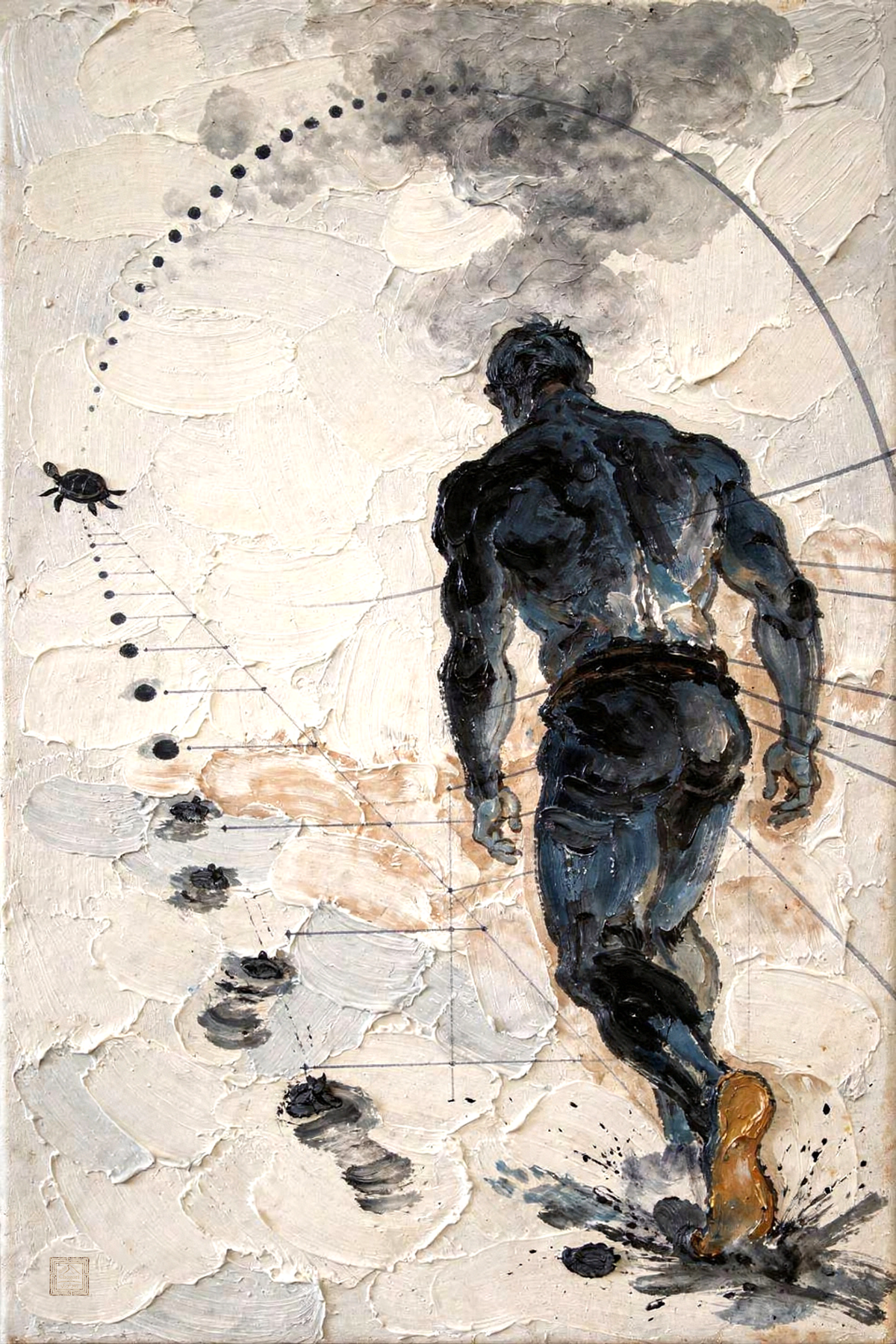
Апории Зенона и остаток движения
Движение, остановка и пределы ясности
Аннотация
Текст возвращается к апории Ахиллеса и черепахи не как к математической загадке, а как к опыту предела определённого способа мыслить движение. Показывается, что решение через пределы и ряды снимает лишь ту трудность, которая уже перевела движение в последовательность остановок. Через феноменологию шага, диалектику Гегеля, мадхьямику Нагарджуны, догэновское «бытие‑время» и простые топологические модели (гармошка, лист Мёбиуса) проступает общий мотив: не движение складывается из остановок, а остановки оседают из движения. Апория Зенона оказывается не аргументом против движения, а испытанием для той ясности, которая признаёт реальным только то, что можно остановить и предъявить.
I
Апория Ахиллеса и черепахи математически решена. Предел и сходящийся ряд показывают: бесконечная делимость пути не делает прохождение невозможным. Противоречие снято — однако снято внутри той формы мысли, которая заранее переводит движение в ряд участков, чтобы затем доказать, что их бесконечность не препятствует завершению. Решена та трудность, которую эта форма умеет поставить и снять.
В этом нет упрёка математике. Её описание строго и действенно в своих границах: оно позволяет измерять, соотносить, вычислять, предсказывать. Ошибка начинается не здесь, а там, где условия такого описания принимают за устройство самого бытия. Путь раскладывают на этапы, время — на моменты, прохождение — на последовательность положений, и порядок анализа принимают за порядок самого движения. Тогда апория возвращается не потому, что решению чего-то недостаёт, а потому, что решено было уже переведённое в форму.
Чтобы знать движение строго, его останавливают. Иначе не будет ни измерения, ни доказательства, ни сравнения. Но вместе с этой остановкой совершается и утрата. Положение показывает, где находится тело, но не содержит его движения. Момент фиксирует время, но в нём нет прохождения. Последовательность состояний даёт порядок, но не даёт перехода. Сколь бы полной ни была такая последовательность, она не порождает становления.
В этом и состоит зоркость Зенона. Он увидел не то, что движение невозможно, а то, что его невозможно извлечь из неподвижного. Становление не выводится из ставшего. Переход не возникает как недостающая часть между двумя завершёнными состояниями. Он утрачивается раньше — в тот миг, когда движение принимают за то, что должно быть сложено из остановленного. Здесь Зенон стоит не против Гераклита, а рядом с ним: всё течёт, но тот, кто хочет уловить течение в виде состояний, обнаруживает лишь их взаимное исключение и объявляет воду невозможной.
II
Апория сохраняет силу, пока движение понимают как производное от остановки. Тогда переход действительно невозможен: в положении нет движения, в моменте нет прохождения, из ряда состояний не получается становление. Но эта невозможность принадлежит не самому движению. Она принадлежит мысли, которая ищет движение там, где оставила только его фиксируемый след.
Отдельные положения не даны сначала, чтобы затем быть связанными движением. Скорее наоборот: поскольку движение уже совершается, можно выделить положения, интервалы, этапы. Остановка вторична. Точка и момент — не кирпичики, из которых складывается движение, а предельные формы его удержания. Они не составляют происходящее, а извлекаются из него как то, что может быть зафиксировано, измерено и повторно предъявлено.
Положительно движение дано не как ряд мест, а как непрерывное смещение, перенос, потеря и обретение опоры, изменение соотнесённости тела с самим собой и с миром. Оно есть не сумма положений, а связность самого перехода. Поэтому его нельзя найти среди уже выделенных точек: выделение точек само возможно лишь на фоне совершающегося движения. Такую инверсию приоритета — от неподвижного к движущему как исходному — в новой форме проведут Бергсон и Мерло‑Понти, но её феноменология доступна каждому шагу.
Это видно в шаге — не в понятии шага, а в самом шаге. Тело не переходит от точки к точке. Оно теряет опору прежде, чем находит новую; движется не неподвижностью, а управляемым падением. Пока нога ещё здесь, тело уже не здесь. Пока опора ещё есть, её уже недостаточно. Шаг начинается там, где положение перестаёт удерживать. И если потом шаг удаётся разложить на фазы, то только потому, что он уже произошёл как единое кинетическое событие.
Невозможно собрать движение из неподвижного. В неподвижном остаётся лишь осадок произошедшего. Не движение строится из остановок — остановки оседают из движения. Если искать движение среди положений, его там не будет. Не потому, что оно слишком быстро или слишком мало для взгляда, а потому, что там оно уже перестало происходить. Точка не скрывает движение — точка и есть его остановленный остаток.
Эти три шага — феноменологический (как движение дано в опыте шага), онтологический (какие отношения между движением и остановкой приписываются самому бытию) и логический (как мысль обращается с противоречием) — не совпадают, хотя и взаимно освещают друг друга. Ход мысли здесь идёт снизу вверх: от описания переживаемого шага к тезису о первичности становления, а затем — к вопросу, какой логике под силу выдержать такое становление.
III
Мысль почти неизбежно принимает этот остаток за само дело. Ей нужно удержать, расчленить, предъявить — и в этом её право и сила: без этого нет ни знания, ни проверки, ни ясности. Но именно здесь начинается подмена. То, что удалось удержать, начинает казаться более действительным, чем то, из чего оно удержано. Так мысль теряет не нечто внешнее себе, а само происходящее — то, внутри чего она тоже совершается.
Гегель увидит в этом структуру рассудка: он цепляется за готовые определения и объявляет противоречие признаком невозможного. У Зенона это противоречие впервые вспыхивает: тело и должно быть и не быть в одном и том же месте, чтобы двигаться. Для рассудка это «доказательство невозможности движения». Для диалектики — знак того, что движение и есть реально существующее противоречие. Но чтобы это увидеть, нужно перестать требовать от действительности логики неподвижных определений.
Поэтому ответ Зенону не может состоять только в опровержении. Недостаточно показать, что сумма бесконечно убывающих отрезков имеет предел. Нужно ещё увидеть, что именно в апории стало явным: не невозможность движения, а склонность мысли признавать действительным прежде всего то, что может быть остановлено и предъявлено. Движение не возникает между точками — точки возникают в нём. Оно не отсутствует в них как недостающая часть; оно предшествует им как условие их выделения. Здесь диалектическая мысль встречается с буддийским критерием реальности: действительным оказывается не то, что неподвижно в себе, а то, что способно действовать — изменять и изменяться.
Отсюда не следует отказ от строгости. Напротив, требуется большая строгость — строгость по отношению к самим средствам анализа. Нужно различать описание и бытие, метод и предмет, операцию удержания и то, что в ней удерживается лишь частично. Ясность необходима, но она не должна тайно решать заранее, что действительным может быть только остановленное. Иначе ясность перестаёт прояснять и начинает подменять.
Мыслить движение — не значит искать его между точками: там уже только следы. Не значит и прибавлять к ряду состояний ещё одно состояние под именем перехода. Переход — не часть ряда, а условие того, что ряд вообще может быть выделен. Движение не скрыто. Его скрывает определённый режим ясности, если он признаёт действительным только предъявимое. Точность мысли начинается там, где остаток перестают принимать за движение.
Интермедия A. Гегель и Нагарджуна о движении
У Гегеля движение прямо определяется как «существующее противоречие». Тело движется не потому, что сначала оно здесь, потом там, а потому, что в одном и том же «здесь» оно одновременно и есть, и его уже нет: позиция подтачивается собственной отрицательностью. Зеноновская трудность для него — не ошибка, а первый симптом того, что мир устроен диалектически: рассудок видит в противоречии знак невозможного, а разум — знак реального.
Нагарджуна подходит с другой стороны. Его анализ не реабилитирует противоречие, а растворяет опоры, которым противоречить. В главе о движении он показывает, что «движение», «движущийся» и «пространство движения» не обнаруживаются ни в прошлом, ни в будущем, ни в выделенном «настоящем», ни как собственные сущности. Всякий раз, когда происходит попытка закрепить движение в носителе, моменте или промежутке, возникают нелепости: двойное движение, движение без движущегося, движущийся без движения. Вывод не в том, что движения нет, а в том, что оно пусто от самобытной сущности; оно существует только как условно обозначаемая зависимость факторов.
Поэтому прямая идентификация гегелевской диалектики и мадхьямики неверна. У Гегеля противоречие, поднятое на уровень понятия, ведёт к всё более богатой позитивной тотальности, для Нагарджуны же анализ разрушает любые притязания на «тотальное» знание и оставляет только пустотность всех опор. То, что у одного раскрывается как логика Абсолютного, у другого служит именно для демонтажа любых претензий на абсолют. Но в обоих случаях Зенонов мотив сохраняется: стоит принять неподвижные определения за подлинно реальное — и движение окажется либо логически невозможным, либо логически необнаружимым. Диалектика и мадхьямика расходятся в исходной метафизике, но сходятся в одном указании: апория — это не порча факта, а сбой способа его мыслить.
IV
То, что апория делает видимым феноменологически, геометрия и разные философские традиции позволяют по‑разному прояснить и разыграть на структурном уровне.
Возьмём как наивную модель полосу, сложенную гармошкой. Рёбра сгибов образуют путь черепахи — от складки к складке. Поверхность между ними — путь Ахиллеса. Рёбра одномерны; поверхность — нет. Сколько бы ни было сгибов, поверхность остаётся поверхностью: связной, непрерывной, той же самой. Сгибы — след того, как её укладывали. Но уложенность не есть устройство.
Если длина полосы равна S, а после складывания она протянулась по прямой на расстояние D, то путь Ахиллеса измеряется D — он идёт «по прямой», перешагивая через складки. Путь черепахи измеряется S: она идёт по всем изгибам, по полной длине. С точки зрения конечного отрезка стороны они стартуют и финишируют вместе: оба оказываются «между теми же точками». Но в метрическом отношении черепаха проходит больше: её путь насыщен сгибами, возвратами, сменами направления. Она преодолевает большее расстояние не за счёт усилий Ахиллеса, а за счёт того, как уложен сам мир.
Аристотель пытался ответить Зенону, различая актуальную и потенциальную бесконечность: отрезок не состоит из бесконечного числа частей, он лишь может делиться без конца. Эта модель позволяет уточнить: конечный отрезок может быть реализован как путь, обладающий разной внутренней сложностью. Одна и та же прямая допускает разные метрики — гладкую для Ахиллеса и складчатую для черепахи. Это, конечно, не доказательство о мире, а способ сделать видимой ту мысль, что топологическая «одинаковость» отрезка ещё ничего не говорит о его кинематической и метрической насыщенности.
Буддийская теория моментарности разворачивает этот мотив иначе: не столько деля время, сколько описывая явления как последовательности кшан — мгновений рождения и исчезновения. В этой модели такое мгновение — ребро: точка, где прямая прерывается и вновь продолжается. Черепаха движется не «между» такими мгновениями, а через них — каждый сгиб есть полная смерть и полное рождение её пути. Нагарджуна радикализует это: движение нельзя отнести ни к тому, кто ещё не двинулся, ни к тому, кто уже остановился, ни к тому, кто «просто движется» — в каждом случае происходит подмена движения неподвижным носителем. На самой полосе нет особого места, где можно было бы локализовать движение: есть поверхность и сгибы, а движение выступает здесь как условие различения и той, и других.
Дзэн подчёркивает то же в иной интонации. Когда Догэн говорит о «бытии-времени», он отказывается мыслить существование как что-то, располагающееся внутри времени. Каждое «сейчас» — это не точка на оси, а целое развёртывание мира. В каждом шаге Ахиллеса и в каждом сгибе черепашьего пути «есть‑время»: не момент внутри движения, а движение как форма присутствия. Зазен, где тело просто сидит, позволяет особенно ясно увидеть движение вне логики дел и этапов.
Если дать полосе полуоборот и склеить концы, возникнет лист Мёбиуса: одно ребро, один непрерывный ход поверхности. Черепаха, уверенная, что движется по границе между внутренним и внешним, обнаруживает: она прошла по всему, не переходя через ничего. Та сторона, которую она принимала за внешнее, оказывается продолжением. Граница не держит двух миров — она описывает один. С точки зрения Гегеля, противоречие «внутреннее/внешнее», «покой/движение» здесь не снято логическим трюком, а реализовано как форма вещи. С точки зрения Нагарджуны, дуальность исчезает не потому, что одна из сторон победила, а потому, что обе никогда не были самосущими.
Апория предполагала именно это: два слоя — фиксируемое и ускользающее, положение и движение, ребро и поверхность, самсара усилий и нирвана покоя. Геометрия, буддийская моментарность, гегелевская диалектика и дзэн показывают не одно и то же, но в одном направлении: ребро не порождает поверхность и не предшествует ей. Оно возникает там, где поверхность однажды согнули — там, где становление на миг приняли за ставшее. Все эти языки говорят об одном, но не говорят одного и того же: каждый приходит к этому месту своим путём — и именно поэтому их схождение здесь не случайно.
Интермедия B. Шаг, сидение и понимающее тело
Мерло‑Понти показывает, что тело не просто имеет движения, а само понимает пространство через них. В нормальном опыте движение не собирается как задача, оно происходит спонтанно: шаг не вычисляется, а происходит как ответ тела на конфигурацию мира. Там, где требуется сознательный расчёт и пошаговый контроль — при нарушениях, при заново вырабатываемой координации — движение деградирует до схемы, которую приходится «додумывать». Это живой опыт разрыва между движением как становлением и движением как последовательностью положений: пока тело действительно движется, ему не нужны точки, чтобы идти; точки появляются, когда движение ослаблено настолько, что его приходится реконструировать.
Зазен и догэновское «бытие‑время» радикализуют ту же интуицию. В сидении «ничего не происходит» с точки зрения дел и задач, но именно поэтому раскрывается то, что обычно скрыто за ними: чистая совпадённость тела и мира в этом «так» — без опоры на цепочку этапов. В феноменологическом плане это не покой против движения, а движение без нарратива: тело не переходит куда‑то, а непрерывно соглашается быть этим положением, этой болью в колене, этим дыханием; и в этом согласии положение постоянно ускользает, не успевая стать полностью «готовым».
Шаг как управляемое падение и сидение как недеяние оказываются двумя полюсами одного и того же: тело никогда не есть набор поз, оно всегда уже в переходе — даже когда формально неподвижно. Если добавить сюда гармонику и лист Мёбиуса, картина замыкается: топология показывает, что одна и та же поверхность допускает сгибы, а опыт тела — что одно и то же положение всегда уже трескается переходом. Зазен делает этот треск ощутимым: ребро не порождает поверхность, а отмечает место её сгиба; так и положение оказывается не основой движения, а его временно удержанным следом.
В заключение можно сказать так: апория Зенона не опровергает движение, а обнаруживает предел того способа мысли, который признаёт действительным прежде всего остановленное, расчленённое и предъявимое. Математическое решение снимает противоречие внутри этой формы описания и тем самым остаётся истинным в своих границах; но оно не отвечает на более исходный вопрос — как возможно мыслить само прохождение, если положение не содержит перехода, момент не содержит длительности, а последовательность состояний не порождает становления. Поэтому трудность Зенона не исчезает вместе с рядом и пределом: она возвращается всякий раз, когда порядок анализа принимают за порядок бытия.
Отсюда следует не отказ от строгости, а требование большей строгости — строгости по отношению к самим средствам удержания. Движение не следует искать между уже выделенными точками и моментами, потому что они сами суть следы произведённой остановки. Не движение складывается из остановок; остановки оседают из движения как его фиксируемый остаток. Если это так, то апория указывает не на невозможность движения, а на вторичность тех форм ясности, в которых оно становится доступным измерению и доказательству. Мыслить движение — значит начинать не с ставшего, а со становления; не с положения, а с перехода; не с остатка, а с того, из чего этот остаток осел. Именно в этом смысле Зенон остаётся современным: он заставляет различать реальное движение и те формы его остановки, без которых невозможно знание, но из которых невозможно вывести само происходящее.
Zeno’s Paradox and the Residue of Motion
Movement, Rest, and the Limits of Clarity
Abstract
This text returns to the paradox of Achilles and the tortoise not as a mathematical puzzle, but as an experience of the limit of a certain way of thinking movement. It argues that the solution through limits and convergent series removes only the difficulty that has already translated motion into a sequence of stops. Through the phenomenology of the step, Hegelian dialectics, Nāgārjuna’s Madhyamaka, Dōgen’s “being-time,” and simple topological models (the accordion fold, the Möbius strip), a common motif comes into view: motion is not composed out of stops; rather, stops precipitate out of motion. Zeno’s paradox turns out to be not an argument against motion, but a test for that kind of clarity which recognizes as real only what can be arrested and displayed.
I
The paradox of Achilles and the tortoise has been solved mathematically. The limit and the convergent series show that the infinite divisibility of a path does not make traversal impossible. The contradiction is removed—but removed within that form of thought which first translates movement into a series of segments, in order then to prove that their infinity does not prevent completion. What has been resolved is the difficulty that this form of thought knows how to pose and how to remove.
There is no reproach to mathematics in this. Within its bounds, its description is rigorous and effective: it allows one to measure, relate, calculate, and predict. The error begins not here, but where the conditions of such description are taken for the structure of being itself. The path is broken into stages, time into moments, passage into a sequence of positions, and the order of analysis is mistaken for the order of movement itself. Then the paradox returns not because something is missing from the solution, but because what was solved had already been translated into form.
To know motion rigorously, one arrests it. Otherwise there can be no measurement, no proof, no comparison. But with this arrest, something is lost. Position shows where a body is, but does not contain its motion. A moment fixes time, but contains no passage. A sequence of states gives order, but does not give transition. However complete such a sequence might be, it does not produce becoming.
This is Zeno’s acuity. He saw not that motion is impossible, but that it cannot be extracted from the motionless. Becoming cannot be derived from what has become. Transition does not arise as the missing part between two completed states. It is lost earlier—at the moment when movement is taken to be something that must be built out of what has been arrested. Here Zeno stands not against Heraclitus, but beside him: everything flows, yet whoever tries to grasp this flow in the form of states finds only their mutual exclusion and declares water impossible.
II
The paradox retains its force as long as motion is understood as derivative from rest. Then transition is indeed impossible: there is no motion in position, no passage in the moment, no becoming in a series of states. But this impossibility does not belong to motion itself. It belongs to thought, which looks for motion precisely where it has left only its fixed trace.
Individual positions are not given first, to be subsequently connected by movement. Rather the opposite: because movement is already taking place, positions, intervals, and stages can be distinguished. Rest is secondary. The point and the moment are not bricks out of which motion is assembled, but limiting forms by which it is held. They do not compose what happens; they are extracted from it as what can be fixed, measured, and presented again.
Positively, motion is not given as a series of places, but as continuous displacement, transfer, the loss and recovery of support, a change in the body’s relation to itself and to the world. It is not the sum of positions, but the connectedness of transition itself. That is why it cannot be found among already isolated points: the very isolation of points is possible only against the background of motion already underway. This inversion of priority—from the motionless to the moving as primary—will later be articulated in new form by Bergson and Merleau-Ponty, but its phenomenology is available in every step.
This becomes clear in the step—not in the concept of the step, but in the step itself. The body does not pass from point to point. It loses support before it finds new support; it moves not by immobility, but by a controlled falling. While the foot is still here, the body is already no longer here. While support is still present, it is already insufficient. The step begins where position ceases to hold. And if afterward the step can be analyzed into phases, this is possible only because it has already taken place as a unified kinetic event.
It is impossible to assemble motion out of the motionless. In the motionless there remains only the sediment of what has happened. Motion is not built out of stops—stops settle out of motion. If one seeks motion among positions, it will not be there. Not because it is too fast or too small for perception, but because there it has already ceased to occur. The point does not conceal motion—the point is its arrested residue.
These three steps—phenomenological (how movement is given in the experience of stepping), ontological (what relation between motion and rest is attributed to being itself), and logical (how thought deals with contradiction)—do not coincide, though they illuminate one another. The movement of the argument here proceeds from below upward: from the description of the lived step, to the thesis of the primacy of becoming, and then to the question of what kind of logic can sustain such becoming.
III
Thought almost inevitably takes this residue for the thing itself. It must hold, divide, display—and in this lies both its right and its power: without this there is no knowledge, no verification, no clarity. But here the substitution begins. What has been successfully held starts to seem more real than that from which it has been held. In this way thought loses not something external to itself, but the very happening within which it too takes place.
Hegel will see here the structure of the understanding: it clings to fixed determinations and takes contradiction as the mark of the impossible. In Zeno this contradiction first flares up: a body must both be and not be in the same place in order to move. For the understanding this is “proof of the impossibility of motion.” For dialectics it is a sign that motion is itself an actually existing contradiction. But to see this one must stop demanding of reality the logic of fixed determinations.
The response to Zeno therefore cannot consist merely in refutation. It is not enough to show that the sum of infinitely decreasing segments has a limit. One must also see what the paradox has made manifest: not the impossibility of motion, but thought’s inclination to recognize as most real what can be arrested and displayed. Motion does not arise between points—points arise within it. It is not absent from them as a missing part; it precedes them as the condition for their distinction. Here dialectical thought meets a Buddhist criterion of reality: what is real is not what is motionless in itself, but what is capable of acting—of changing and of being changed.
This does not entail a rejection of rigor. On the contrary, it demands a greater rigor—a rigor directed toward the very means of analysis themselves. One must distinguish description from being, method from object, the operation of holding from that which in it is only partially held. Clarity is necessary, but it must not secretly decide in advance that only the arrested can be real. Otherwise clarity ceases to clarify and begins to substitute.
To think motion is not to look for it between points: there one finds only traces. Nor is it to add to a series of states one more state under the name of transition. Transition is not a part of the series, but the condition under which the series can be distinguished at all. Motion is not hidden. What hides it is a certain regime of clarity, if that regime recognizes as real only what can be presented. Precision of thought begins where residue ceases to be taken for motion.
Interlude A. Hegel and Nāgārjuna on Motion
For Hegel, motion is directly defined as an “existing contradiction.” A body moves not because it is first here and then there, but because in one and the same “here” it both is and is already no longer there: position is undermined by its own negativity. Zeno’s difficulty is for him not an error, but the first symptom that the world is dialectically constituted: the understanding sees contradiction as the sign of the impossible, whereas reason sees it as the sign of the real.
Nāgārjuna approaches from another side. His analysis does not rehabilitate contradiction, but dissolves the supports to which contradiction would attach. In the chapter on motion, he shows that “motion,” the “mover,” and the “space of motion” are not to be found in the past, the future, the isolated “present,” nor as self-subsistent entities. Whenever one tries to secure motion in a bearer, a moment, or an interval, absurdities arise: double motion, motion without a mover, a mover without motion. The conclusion is not that motion does not exist, but that it is empty of self-subsisting essence; it exists only as a dependently designated relation among factors.
For this reason, a direct identification of Hegelian dialectics with Madhyamaka would be mistaken. In Hegel, contradiction raised to the level of the concept leads toward an ever richer positive totality; for Nāgārjuna, analysis dismantles all claims to total knowledge and leaves only the emptiness of all supports. What in one unfolds as the logic of the Absolute serves in the other precisely to disassemble every pretension to the absolute. Yet in both cases the Zenonian motif remains: once fixed determinations are taken as what is truly real, motion becomes either logically impossible or logically undiscoverable. Dialectics and Madhyamaka diverge in their underlying metaphysics, but converge in one indication: the paradox is not a corruption of the fact, but a failure in the way of thinking it.
IV
What the paradox makes visible phenomenologically can also be clarified and staged at a structural level through geometry and different philosophical traditions.
Take, as a naive model, a strip folded like an accordion. The edges of the folds form the tortoise’s path—from fold to fold. The surface between them is Achilles’ path. The edges are one-dimensional; the surface is not. However many folds there are, the surface remains a surface: connected, continuous, the same. The folds are the trace of how it has been arranged. But arrangement is not structure.
If the length of the strip is S, and after folding it extends in a straight line over a distance D, then Achilles’ path is measured by D: he goes “straight,” stepping across folds. The tortoise’s path is measured by S: it follows every bend, the full length. From the standpoint of the finite segment, they begin and end together: both are “between the same points.” But metrically the tortoise travels more: its path is saturated with folds, returns, and changes of direction. It overcomes a greater distance not because of Achilles’ efforts, but because of the way the world itself has been folded.
Aristotle tried to answer Zeno by distinguishing actual from potential infinity: a segment is not composed of infinitely many parts, it can only be divided without end. This model makes it possible to refine the point: a finite segment can be realized as a path possessing different internal complexity. The same straight line can sustain different metrics—smooth for Achilles, folded for the tortoise. This is of course not a proof about the world, but a way of rendering visible the thought that the topological “sameness” of a segment says nothing yet about its kinematic or metric density.
Buddhist theories of momentariness unfold this motif differently: not so much by dividing time as by describing phenomena as sequences of kṣaṇas—moments of arising and vanishing. In this model, such a moment is an edge: a point where the line breaks off and begins again. The tortoise moves not “between” such moments, but through them—each fold is the complete death and complete birth of its path. Nāgārjuna radicalizes this: motion can be attributed neither to one who has not yet moved, nor to one who has already stopped, nor to one who is “simply moving”—in every case movement is replaced by a motionless bearer. On the strip itself there is no special place where motion can be localized: there is the surface and the folds, while motion appears here as the condition for distinguishing both.
Zen emphasizes the same in another tone. When Dōgen speaks of “being-time,” he refuses to think existence as something located within time. Each “now” is not a point on a line, but a total unfolding of the world. In every step of Achilles and in every fold of the tortoise’s path there is being-time: not a moment inside movement, but movement as a mode of presence. Zazen, where the body simply sits, makes it especially clear that motion can appear outside the logic of tasks and stages.
If the strip is given a half-twist and its ends are joined, a Möbius strip appears: one edge, one continuous course of the surface. The tortoise, certain that it is moving along the boundary between inner and outer, discovers that it has traversed the whole without crossing anything. What it took to be the outer side turns out to be continuation. The boundary does not hold apart two worlds—it describes one. From Hegel’s point of view, the contradiction “inner/outer,” “rest/motion,” is not dissolved by a logical trick, but realized as the form of the thing. From Nāgārjuna’s point of view, duality disappears not because one side has defeated the other, but because neither side was ever self-subsistent.
The paradox presupposed precisely this: two layers—the fixed and the elusive, position and motion, edge and surface, the saṃsāra of effort and the nirvāṇa of repose. Geometry, Buddhist momentariness, Hegelian dialectics, and Zen do not show the same thing, but they point in one direction: the edge does not generate the surface and does not precede it. It arises where the surface has once been folded—where becoming was for a moment taken as having become. All these languages speak of one thing, but do not say the same thing: each arrives at this place by its own path, and for that very reason their convergence here is not accidental.
Interlude B. The Step, Sitting, and the Understanding Body
Merleau-Ponty shows that the body does not merely have movements, but itself understands space through them. In normal experience, movement is not assembled as a problem; it happens spontaneously: the step is not calculated, but occurs as the body’s response to the world’s configuration. Where conscious calculation and step-by-step control are required—in disturbance, in newly acquired coordination—movement degrades into a schema that has to be thought through. This is a living experience of the rupture between movement as becoming and movement as a sequence of positions: so long as the body truly moves, it does not need points in order to walk; points appear when movement has weakened enough that it must be reconstructed.
Zazen and Dōgen’s “being-time” radicalize the same intuition. In sitting, “nothing happens” from the standpoint of tasks and goals, yet precisely for that reason what is usually hidden behind them becomes manifest: the pure coincidence of body and world in this thusness—without reliance on a chain of stages. Phenomenologically, this is not rest opposed to motion, but motion without narrative: the body does not move toward somewhere else, but continuously consents to be this position, this pain in the knee, this breath; and in that consent the position constantly slips away, never quite becoming fully “ready.”
The step as controlled falling and sitting as non-doing turn out to be two poles of one and the same: the body is never a set of postures, it is always already in transition—even when formally still. If one adds to this the accordion fold and the Möbius strip, the picture closes: topology shows that one and the same surface admits folds, while bodily experience shows that one and the same position is always already cracking with transition. Zazen makes this crack palpable: the edge does not generate the surface, but marks the place of its fold; so too position turns out to be not the basis of movement, but its temporarily retained trace.
In conclusion, Zeno’s paradox does not refute motion; it reveals the limit of a mode of thought that recognizes as real above all what can be arrested, divided, and displayed. The mathematical solution removes the contradiction within that form of description and therefore remains true within its proper bounds; but it does not answer the more fundamental question of how passage itself is to be thought, if position contains no transition, the instant contains no duration, and a sequence of states does not generate becoming. For this reason, Zeno’s difficulty does not disappear with the series and the limit. It returns whenever the order of analysis is mistaken for the order of being.
What follows is not a rejection of rigor, but a demand for a greater rigor — a rigor directed toward the very means by which thought holds and fixes its object. Motion is not to be sought between already isolated points and moments, because these are themselves traces of an arrest. Motion is not composed out of stops; rather, stops precipitate out of motion as its fixable residue. If this is so, then the paradox points not to the impossibility of motion, but to the secondary status of those forms of clarity in which motion becomes available to measurement and proof. To think motion means to begin not from what has become, but from becoming; not from position, but from transition; not from the residue, but from that out of which the residue has settled. In this sense Zeno remains our contemporary: he compels us to distinguish real motion from the forms of its arrest — forms without which knowledge is impossible, yet from which the happening itself can never be derived.
Saatchi Art Description:
Zeno’s paradox of Achilles and the tortoise is usually treated as a mathematical problem solved by limits and convergent series. But that solution addresses only a difficulty that has already translated motion into a sequence of fixed positions. The deeper question is different: can movement really be derived from stillness?
This work approaches the paradox not as a proof against motion, but as a test of a certain kind of clarity — one that recognizes as real only what can be stopped, measured, and displayed. A position shows where a body is, but not its moving. A moment fixes time, but not passage. Motion is not built out of stops; stops precipitate out of motion.
Drawing on the phenomenology of the step, Hegelian dialectics, Nāgārjuna’s critique of fixed essence, Dōgen’s being-time, and simple topological figures such as the accordion fold and the Möbius strip, the work asks what remains of movement once it has been arrested by thought.